qas30

--== It is Not Random But Designs ==--
Having trading discipline is the beginning; keeping discipline is the progress;
staying discipline is the success

Currency Wars: The Greatest Currency Trades Ever Made

Published on: Kamis, 06 Februari 2014 in , ,
The foreign exchange (forex) market is the largest market in the world because currency is changing hands whenever goods and services are traded between nations. The sheer size of the transactions going on between nations provides arbitrage opportunities for speculators, because the currency values fluctuate by the minute. Usually these speculators make many trades for small profits, but sometimes a big position is taken up for a huge profit or, when things go wrong, a huge loss. In this article, we'll look at the greatest currency trades ever made.

Currency Wars: Three of the Biggest Currency Raids in History
The Currency Raids of George Soros and Andrew Krieger

In 1987, Andy Krieger, a 32-year-old currency trader at Bankers Trust, was carefully watching the currencies that were rallying against the dollar following the Black Monday crash. As investors and companies rushed out of the American dollar and into other currencies that had suffered less damage in the market crash, there were bound to be some currencies that would become fundamentally overvalued, creating a good opportunity for arbitrage. The currency Krieger targeted was the New Zealand dollar, also known as the kiwi.

Using the relatively new techniques afforded by options, Krieger took up a short position against the kiwi worth hundreds of millions of dollars. In fact, his sell orders were said to exceed the money supply of New Zealand. The selling pressure combined with the lack of currency in circulation caused the kiwi to drop sharply. It yo-yoed between a 3 and 5% loss while Krieger made millions for his employers.

One part of the legend recounts a worried New Zealand government official calling up Krieger's bosses and threatening Bankers Trust to try to get Krieger out of the kiwi. Krieger later left Bankers Trust to go work for George Soros.  

Throughout history there have been raids on financial markets.  Sometimes the raids are malicious – an attempt to corner a market or push the price to an artificially low or high price.  In other situations a raid is simply taking a huge calculated bet on what the trader sees as an inevitable outcome.  The size of the bet has the added effect of often forcing the hands of other traders and politicians to see the error in the ways, thus moving the currency in the raiders favor.  Such raids are a statement by the speculator about policy, regulations, manipulation or the current unsustainable price of a currency.
Two traders took huge positions in the Pound and Kiwi which ultimately resulted in sharp declines and huge profits from the respective currency meltdowns.  The currency raids in these instances were not necessarily malicious (although some may view them as such), but the huge positions did cause the currencies to decline much quicker than they may have otherwise.


Get an instant and free short, medium and long-term trend analysis of the EURUSD or USDJPY
Currency Raids – $300 million Kiwi Currency Raid'
It is autumn, 1987 and Andrew Krieger, a trader at Bankers Trust, is watching the New Zealand dollar (NZD) in the aftermath of the 1987 stock market crash.  Currencies such as the NZD (also called the “Kiwi”) are being bid up by traders fearful of holding US dollars.  This leads to a short-term overvaluation of many currencies relative to the USD, but Krieger focused on the Kiwi.
New Zealand has a fairly small economy, and using options Krieger is able to ultimately short the entire money supply of New Zealand (according his book The Money Bazaar).  This would have been impossible if he only used the cash market.
Other traders and even the New Zealand government get involved.  The government asks Krieger to stop the raid, but ultimately the market agrees with Krieger.   The Kiwi sells-off 5% in a single day, with intra-day fluctuations up to 10% according to some sources.  Much of the decline is pinned on Krieger selling massive amounts of Kiwi dollars, yet it is also other traders acting on the information which ultimately leads to Krieger being exit his positions with a profit.
The estimated profit to Bankers Trust was $300 million.  Of which Krieger got a $3 million bonus.  This “tiny” bonus on such a well executed trade disgusted Krieger and ultimately he left Bankers Trust, going to work for George Soros in 1988.
In 1988 Bankers Trust admitted that profits from their options trading activity was overstated by $80 million in Q4 of 1987.  Therefore the profits made specifically by Krieger are drawn into question, as the many of the options that were revalued involved Kiwi dollars.  Such options were fairly new, and it is possible that Krieger was much of the market in such instruments at the time, making the options hard to value.
Either way, Krieger’s position is estimated to have been $700 million to $1 billion, with profits in the range of $220 (lowest possible gain) to $300 million.
Currency Raids – Conclusion
In both these cases, Soros and Krieger made massive bets that the rates in the GBP and NZD were unsustainably high.  Whether the traders caused the decline is ultimately questionable, but there is no doubt that the large positions frightened the market in the speculator’s direction and made the market realize these currencies were overvalued.
In the case of Soros, he saw an economic and political situation which could not sustain a high GBP price.  Krieger shorted massive amounts of the Kiwi, thinking it was artificially high after the 1987 stock market panic.  Both traders capitalized on what they viewed as an overpriced currency, and very effectively helped to bring the currency back in line with what they believed to be a more fair value.


Stanley Druckenmiller Bets on the Mark - TwiceStanley Druckenmiller made millions by making two long bets in the same currency while working as a trader for George Soros' Quantum Fund.

Druckenmiller's first bet came when the Berlin Wall fell. The perceived difficulties of reunification between East and West Germany had depressed the German mark to a level that Druckenmiller thought extreme. He initially put a multimillion-dollar bet on a future rally until Soros told him to increase his purchase to 2 billion German marks. Things played out according to plan and the long position came to be worth millions of dollars, helping to push the returns of the Quantum Fund over 60%.
Possibly due to the success of his first bet, Druckenmiller also made the German mark an integral part of the greatest currency trade in history. A few years later, while Soros was busy breaking the Bank of England, Druckenmiller was going long in the mark on the assumption that the fallout from his boss' bet would drop the British pound against the mark. Druckenmiller was confident that he and Soros were right and showed this by buying British stocks. He believed that Britain would have to slash lending rates, thus stimulating business, and that the cheaper pound would actually mean more exports compared to European rivals. Following this same thinking, Druckenmiller bought German bonds on the expectation that investors would move to bonds as German stocks showed less growth than the British. It was a very complete trade that added considerably to the profits of Soros' main bet against the pound.

George Soros Vs. the British PoundThe British pound shadowed the German mark leading up to the 1990s even though the two countries were very different economically. Germany was the stronger country despite lingering difficulties from reunification, but Britain wanted to keep the value of the pound above 2.7 marks. Attempts to keep to this standard left Britain with high interest rates and equally high inflation, but it demanded a fixed rate of 2.7 marks to a pound as a condition of entering the European Exchange Rate Mechanism (ERM).

Many speculators, George Soros chief among them, wondered how long fixed exchange rates could fight market forces, and they began to take up short positions against the pound. Soros borrowed heavily to bet more on a drop in the pound. Britain raised its interest rates to double digits to try to attract investors. The government was hoping to alleviate the selling pressure by creating more buying pressure.

Paying out interest costs money, however, and the British government realized that it would lose billions trying to artificially prop up the pound. It withdrew from the ERM and the value of the pound plummeted against the mark. Soros made at least $1 billion off this one trade. For the British government's part, the devaluation of the pound actually helped, as it forced the excess interest and inflation out of the economy, making it an ideal environment for businesses.


Currency Raids – George Soros and the $1 billion Profit
Leading up to Black Wednesday on September 16, 1992 when the British government was forced out of the European Exchange Rate Mechanism (ERM), there were many issues facing Britain.
The ERM required that Britain maintain the currency from fluctuating more than 6% against other currencies within the ERM.  The problem was that at the time Britain had an inflation rate three times that of Germany.  The ERM was also under attack itself as member countries felt the model would not work in the face of real-world issues. Britain falsely assumed that by joining the ERM inflation would be curbed – after all, Germany was part of the ERM and it had a very low inflation rate at the time.

George Soros saw through this tactic.   He correctly calculated that joining the ERM would do nothing to help the Pound, but would likely only hold the currency at artificially high levels.  With nothing substantial to hold the currency up it would eventually come crashing down as Britain was forced to realize the ERM could not save it from declining.

George Soros and other speculators shorted the Pound leading up to September 16, expecting that policy makers would be unable to support the currency above the fluctuation band it was mandated to adhere to.  In return, the Treasury tried to offset the speculators selling by buying Pounds.  This temporarily allowed the Pound to stay within “the band,” but ultimately even the Treasury couldn’t support the currency.  The Pound began to fall and British government got desperate.

On September 16, the government raised interest rates from 10% to 12% in attempt to bring buying support into the GBP.  The plan didn’t work and the Pound continued to fall. The massive interest rate hike was seen as a desperate attempt, and a very real signal, that the Pound was in big trouble.  More sellers flooded the market and that same day Britain said interest rates were moving up to 15%.  The announcement had little effect and was ultimately was not implemented.  Faced with a falling Pound and being unable to stabilize the currency within the band, Britain was forced to withdraw from the ERM.

In September alone the GBP/USD fell 15%, but the fallout continued.  By December the pair had fallen 25.4% – from a 2.0085 high in September to a 1.4980 low in December, 1992.
The falling Pound ultimately allowed the British economy to rebuild. It is for this reason September 16, 1992 is also called “Golden Wednesday.”

A Thankless JobAny discussion around the top currency trades always revolves around George Soros, because many of these traders have a connection to him and his Quantum Fund. After retiring from active management of his funds to focus on philanthropy, Soros made comments about currency trading that were seen as expressing regret that he made his fortune attacking currencies. It was an odd change for Soros who, like many traders, made money by removing pricing inefficiencies from the market. Britain did lose money because of Soros and he did force the country to swallow the bitter pill of withdrawing from the ERM, but many people also see these drawbacks to the trade as necessary steps that helped Britain emerge stronger. If there hadn't been a drop in the pound, Britain's economic problems may have dragged on as politicians kept trying to tweak the ERM.
The Bottom LineA country can benefit from a weak currency as much as from a strong one. With a weak currency, the domestic products and assets become cheaper to international buyers and exports increase. In the same way, domestic sales increase as foreign products go up in price due to the higher cost of importing. There were very likely many people in Britain and New Zealand who were pleased when speculators brought down the overvalued currencies. Of course, there were also importers and others who were understandably upset. A currency speculator makes money by forcing a country to face realities it would rather not face. Although it's a dirty job, someone has to do it.

George Soros-The Man who broke the Bank of England

Published on: Selasa, 04 Februari 2014 in , ,
When George Soros placed a $10 billion speculative bet against the U.K. pound and won, he became universally known as "the man who broke the Bank of England." Whether you love him or hate him, Soros led the charge in one of the most fascinating events in currency trading history. 

The United Kingdom Joins the Exchange Rate Mechanism 

In 1979, a Franco-German initiative set up the European Monetary System (EMS) in order to stabilize exchange rates, reduce inflation, and prepare for monetary integration. The Exchange Rate Mechanism (ERM), one of the EMS 's main components, gave each participatory currency a central exchange rate against a basket of currencies, the European Currency Unit (ECU). Participants (initially France, Germany , Italy , the Netherlands , Bel­gium , Denmark , Ireland , and Luxembourg ) were then required to maintain their exchange rates within a 2.25 percent fluctuation band above or be­low each bilateral central rate. The ERM was an adjustable-peg system, and nine realignments would occur between 1979 and 1985. While the United Kingdom was not one of the original members, it would eventually join in 1990 at a rate of 2.95 deutsche marks to the pound and with a fluc­tuation band of +/- 6 percent. 

Until mid-1992, the ERM appeared to be a success, as a disciplinary ef­fect had reduced inflation throughout Europe under the leadership of the German Bundesbank. The stability wouldn't last, however, as international investors started worrying that the exchange rate values of several curren­cies within the ERM were inappropriate. Following German reunification in 1989, the nation's government spending surged, forcing the Bundesbank to print more money. This led to higher inflation and left the German cen­tral hank with little choice but to increase interest rates. But the rate hike had additional repercussions—because it placed upward pressure on the German mark. This forced other central banks to raise their interest rates as well, so as to maintain the pegged currency exchange rates (a direct ap­plication of Irving Fishers interest rate parity theory). Realizing that the United Kingdom 's weak economy and high unemployment rate would not permit the British government to maintain this policy for long, George Soros stepped into action. 

Soros Bets Against Success of U.K. Involvement in ERM 

The Quantum hedge fund manager essentially wanted to bet that the pound would depreciate because the United Kingdom would either de­value the pound or leave the ERM. Thanks to the progressive removal of capital controls during the EMS years, international investors at the time had more freedom than ever to take advantage of perceived disequilibri­ums, so Soros established short positions in pounds and long positions in marks by borrowing pounds and investing in mark-denominated assets. He also made great use of options and futures. In all, his positions ac­counted for a gargantuan $10 billion. Soros was not the only one: many other investors soon followed suit. Everyone was selling pounds, placing tremendous downward pressure on the currency. 

At first, the Bank of England tried to defend the pegged rates by buy­ing 15 billion pounds with its large reserve assets, but its sterilized inter­ventions (whereby the monetary base is held constant thanks to open market interventions) were limited in their effectiveness. The pound was trading dangerously close to the lower levels of its fixed band. On Septem­ber 16, 1992 , a day that would later be known as Black Wednesday, the bank announced a 2 percent rise in interest rates (from 10 percent to 12 percent) in an attempt to boost the pound's appeal. A few hours later, it promised to raise rates again, to 15 percent, but international investors such as Soros could not be swayed, knowing that huge profits were right around the corner. Traders kept selling pounds in huge volumes, and the Bank of England kept buying them until, finally, at 7:00 p.m. that same day, Chancellor Norman Lamont announced Britain would leave the ERM and that rates would return to their initial level of 10 percent. The chaotic Black Wednesday marked the beginning of a steep depreciation in the pounds effective value. 

Whether the return to a floating currency was due to the Soros-led attack on the pound or because of simple fundamental analysis is still debated today. What is certain, however is that the pound's depreciation of almost 15 percent against the deutsche mark and 25 percent against the dollar over the next five weeks (a s seen in Figure 2.2 and Figure 2.3) re­sulted in tremendous profits for Soros and other traders. Within a month, the Quantum Fund rushed in on approximately $2 billion by selling the now more expensive deutsche marks and buying back the now cheaper pounds. “The man who broke the Bank of England” showed how central banks can still be vulnerable to speculative attacks.
Figure 2.2 GBP/DEM After Soros
Figure 2.3 GBP/USD After Soros

Trading Wisdom From Retiring Legend Bruce Kovner

Published on: Senin, 04 November 2013 in
Bruce Kovner, one of the original Commodities Corp superstars, is hanging up his jersey after 28 years of trading. Via Bloomberg:
Bruce Kovner, the billionaire co- founder of Caxton Associates LP, is retiring from the $10 billion hedge fund, ending a three-decade run during which he traded everything from soybeans to Japanese yen futures and returned twice as much as the Standard & Poor’s 500 Index.
“After 34 years in the trading business and more than 28 years leading Caxton, the time has come to hand the leadership of the company to a new generation,” Kovner, 66, wrote…
Kovner’s main Caxton Global Investment fund has returned an average of 21 per cent a year since inception, compared with an average gain of 11 per cent including dividends by the Standard & Poor’s 500 Index. The $7 billion fund had one losing year, in 1994, when it fell 2.5 per cent. Since 1983, the S&P has fallen in five calendar years, including a 37 per cent decline in 2008. The top returns have helped Kovner amass a fortune estimated at $4.5 billion, according to Forbes magazine.
Kovner was also one of the best interviews in the original Market Wizards series.
Some selected excerpts below jump:

On protecting emotional equilibrium:
To this day, when something happens to disturb my emotional equilibrium and my sense of what the world is like, I close out all positions related to that event.

On the first rule of trading:
The first rule of trading — there are probably many first rules — is don’t get caught in a situation in which you can lose a great deal of money for reasons you don’t understand.

On making a million:
Michael [Marcus] taught me one thing that was incredibly important… He taught me that you could make a million dollars. He showed me that if you applied yourself, great things could happen. It is very easy to miss the point that you really can do it. He showed me that if you take a position and use discipline, you can actually make it.”

On allowing for mistakes:
He also taught me one other thing that is absolutely critical: You have to be willing to make mistakes regularly; there is nothing wrong with it. Michael taught me about making your best judgment, being wrong, making your next best judgment, being wrong, making your third best judgment, and then doubling your money.

On elements of a successful trading:
I’m not sure one can really define why some traders make it, while others do not. For myself, I can think of two important elements. First, I have the ability to imagine configurations of the world different from today and really believe it can happen. I can imagine that soybean prices can double or that the dollar can fall to 100 yen. Second, I stay rational and disciplined under pressure.
[Successful traders are] strong, independent, and contrary in the extreme. They are able to take positions others are unwilling to take. They are disciplined enough to take the right size positions. A greedy trader always blows out.

On having a market view:
I almost always trade on a market view; I don’t trade simply on technical information. I use technical analysis a great deal and it is terrific, but I can’t hold a position unless I understand why the market should move.
…there are well-informed traders who know much more than I do. I simply put things together… The market usually leads because there are people who know more than you do.
On technical analysis:
Technical analysis, I think, has a great deal that is right and a great deal that is mumbo jumbo… There is a great deal of hype attached to technical analysis by some technicians who claim that it predicts the future. Technical analysis tracks the past; it does not predict the future. You have to use your own intelligence to draw conclusions about what the past activity of some traders may say about the future activity of other traders.

…For me, technical analysis is like a thermometer. Fundamentalists who say they are not going to pay any attention to the charts are like a doctor who says he’s not going to take a patient’s temperature. But, of course, that would be sheer folly. If you are a responsible participant in the market, you always want to know where the market is — whether it is hot and excitable, or cold and stagnant. You want to know everything you can about the market to give you an edge.
…Technical analysis reflects the voice of the entire marketplace and, therefore, does pick up unusual behaviour. By definition, anything that creates a new chart pattern is something unusual. It is very important for me to study the details of price action to see if I can observe something about how everybody is voting. Studying the charts is absolutely critical and alerts me to existing disequilibria and potential changes.

On trading ranges and price patterns:
…as a trader who has seen a great deal and been in a lot of markets, there is nothing disconcerting to me about a price move out of a trading range that nobody understands.
…Tight congestions in which a breakout occurs for reasons that nobody understands are usually good risk/reward trades.

…The more a price pattern is observed by speculators, the more prone you are to have false signals. The more a market is the product of nonspeculative activity, the greater the significance of technical breakouts.
…The general rule is: the less observed, the better the trade.
On predetermined risk points:
Whenever I enter a position, I have a predetermined stop. That is the only way I can sleep. I know where I’m getting out before I get in. The position size on a trade is determined by the stop, and the stop is determined on a technical basis… I always put my stop behind some technical barrier.”
I never think about [stop vulnerability], because the point about a technical barrier — and I’ve studied the technical aspects of the market for a long time — is that the market shouldn’t go there if you are right.

On the emotional burden of trading: 
The emotional burden of trading is substantial; on any given day, I could lose millions of dollars. If you personalise these losses, you can’t trade.

On imagining alternative scenarios:
One of the jobs of a good trader is to imagine alternative scenarios. I try to form many different mental pictures of what the world should be like and wait for one of them to be confirmed. You keep trying them on one at at a time. Inevitably, most of these pictures will turn out to be wrong — that is, only a few elements of the picture may prove correct. But then, all of a sudden, you will find that in one picture, nine out of 10 elements click. That scenario then becomes your image of the world reality.

On seeking vulnerable consensus:
What I am really looking for is a consensus the market is not confirming. I like to know that there are a lot of people who are going to be wrong.

On stocks vs commodities:
The stock market has far more short-term countertrends. After the market has gone up, it always wants to come down. The commodity markets are driven by supply and demand for physical goods; if there is a true shortage, prices will tend to keep trending higher.

On trading too big:
My experience with novice traders is that they trade three to five times too big. They are taking 5 to 10 per cent risks on a trade when they should be taking 1 to 2 per cent risks.

On the dangers of correlation:
Through bitter experience, I have learned that a mistake in position correlation is the root of some of the most serious problems in trading. If you have eight highly correlated positions, then you are really trading one position that is eight times as large.

Larry R. Williams

Published on: Sabtu, 18 Mei 2013 in


Seorang lulusan jurnalistik University of Oregon ini pernah mengubah sebuah account realnya dari sebesar hanya $10.000 menjadi $1.147.000 dalam waktu hanya 12 bulan pada sebuah perlombaan trading yang diselenggarakan oleh Robbins Trading Company. Belum pernah ada yang menyamainya ketika rekor profit ini dibuat oleh Williams. Bila Anda pernah mendengar indikator bernama Williams %R, Anda sedang menatap foto penemunya saat ini dilayar komputer Anda.

Larry R. Williams dikenal sebagai seorang analis trader komoditi dan saham. Larry R. Williams adalah lulusan dari universitas University of Oregon, dengan gelar BS pada jurusan Jurnalistik.
Pada tahun 1982 bukunya yang berjudul “How to Prosper in the Coming Good Years” diterbitkan. Prediksi yang terdapat dalam bukunya mengatakan bahwa gelombang kenaikan harga saham akan menjadi kenyataan. Buku itu ditulis ketika banyak orang terkemuka kala itu pesimis bahwa pertumbuhan ekonomi dan nilai saham akan terus berjalan melambat akhirnya membenarkan prediksi William.
Pada tahun 1987, Williams memenangkan perlombaan World Cup Championship of Futures Trading, yang disponsori oleh perusahaan Robbins Trading Company dengan cara bertrading dengan modal awal $10.000 dengan uang nyata menjadi $ 1.147.000 dalam 12 bulan yang merupakan rekor dimana tak seorangpun yang menyamainya saat itu. Sebuah momen yang tak terlupakan dimana Williams memenangkan uang lebih dari $ 2.000.000 pada akhir September, merugi $750.000 pada bulan Oktober 1987, dan akhirnya mendapatkan $ 1.147.000 pada akhir tahun.
Ketika ada komentar miring yang mengatakan bahwa Williams memegang dua akun selama kompetisi-satu menang dan satu kalah-pihak CFTC dan NFA membuktikan bahwa hal itu adalah sebuah pernyataan yang tidak benar. Kompetisi yang diikuti Williams disponsori oleh National Futures Association dan Commodity Futures Trading Commission.

Pada tahun 1997, saat anak perempuannya, Michelle Williams, berumur 16 tahun menggunakan cara Williams bertrading pada kompetisi yang sama dan mendapatkan keuntungan 1000% pada modal awal sebesar US$ 10.000.

Pada tahun 1998, ia menerima gelar sebagai First Doctor of Futures Award dan juga Omega Research’s Lifetime Achievement Award pada tahun berikutnya. Secara khusus dia juga membuat dua buah indikator teknikal yaitu Williams %R & Ultimate Oscillator. Williams juga dikenal sebagai pengarang buku komoditi yang berjudul Commitment of Trader Reports yang merupakan karya teranyarnya.
Williams sempat ditahan di Australia karena diduga melarikan diri dari membayar pajak di Amerika. Pada bulan Maret 2007 dia memenangkan perkara tersebut dan pada tanggal 2 Agustus 2007 pemerintah Federal setempat membebaskannya tetapi dengan uang jaminan $AUD 1.000.000.

Ed Seykota

Published on: in


Meskipun nyaris tidak dikenal baik bagi masyarakat umum maupun komunitas keuangan, namun keberhasilannya dapat membuatnya dikategorikan sebagai salah satu trader terbaik di masanya. Pada awal tahun 70an, Ed Seykota bekerja di salah satu perusahaan pialang terkemuka saat itu dan mengembangkan sistem trading komersial pertama yang berbasiskan komputer. Sistem tersebut digunakan dalam pasar komoditi dan dengan hasil yang cukup mengesankan tapi campur tangan dari perusahaan mengakibatkan turunnya performance tradingnya.
Salah satu orang yang menggunakan sistemnya dalam live account dan mulai trading dengan US$ 5,000, 12 tahun kemudian dananya telah meningkat menjadi US$ 15 juta. Ed merupakan salah satu pelopor ‘Mechanical Trading‘.

Edward Arthur Seykota atau biasa lebih dikenal dengan nama Ed Seykota lahir pada tanggal 7 Agustus 1946. Dia dikenal sebagai seorang komoditi trader. Beliau mendapatkan gelar B. Sc. Pada bidang teknik elektro dan manajemen dari MIT di tahun 1969.

Hingga akhir tahun 1960 Ed Saykota bertrading di U.S. Treasury. Lalu ia beralih ke komoditi trading. Brokernya menawarkan kontrak perdagangan tembaga. Dia mengalami kerugian saat pertama kali bertrading. Lalu ia beralih ke perak. Posisi Buy dipilih oleh Ed. Ternyata harga perak jatuh dan menyentuh posisi Stop Lossnya. Loss dua kali membuat Ed belajar banyak hal dimana betapa mengagumkannya pergerakan market. Ed membaca buku karangan Richard Donchian, yang memberikan pengajaran tentang sebuah mekanisme sistem trading yang mengalahkan pasar. Pertama kali membaca, Ed langsung berkomentar hal itu adalah tidak mungkin. Ed kemudian membuat program komputer dan langsung ditest saat bertrading. Terbukti teori Richard Donchian betul. Kesimpulannya dengan mempelajari market, kita dapat mempraktekan trading for living (trading untuk hidup) dalam kehidupan kita.
Salah satu keunikan Ed Seykota dibanding trader lainnya adalah evaluasi diri yang secara terus menerus dan perhatiannya yang sangat besar tentang psikologi dalam trading. Sementara trader-trader lain kebanyakan melakukan trading secara mechanical, Ed seykota melakukan kombinasi antara mechanical dan non-mechanical (judgemental).

Methodology

Basic dari peraturan trend trading menrut Ed Saykota adalah :
1. Bertradinglah dengan menggunakan trend trading
2. Pelajari tentang cut loss dan jadilah pemenang selalu.
3. Gunakan manajemen resiko
Trend
Banyak trader menanyakan apa definisi dari Trend kuat menurut Ed. Berikut adalah definisinya :
1. Lebih kuat atau lebih tinggi dari nilai yang diprediksikan.
2. Potensial. Mempunyai atau mempunyai kemampuan untuk naik atau turun lebih lagi.
3. Kuat(tidak terkalahkan) : dapat menanggung segala koreksi keatas maupun ke bawah.
Resiko
Menurut Ed, resiko yang dapat kita ambil setiap kali bertrading Forex adalah 0.5 – 25% dari Equity.

Performance

  • Pada tahun 1970 ia mempelopori sebuah sistem trading yang terkomputerisasi untuk pasar futures. Pada dasarnya sistem trading yang dikembangkannya berasal dari exponetial moving averages (SMA)
  • Performance trading pribadinya tidak pernah dibuka secara umum, namun ada orang di bawah binaanya mencapai performance sampai 250,000% dalam live accountnya.
  • Guru dari banyak trader terkenal lainnya termasuk Michael Marcus, David Druz, Jim Hamer, Jason Dekker, Michael Stephani, dan Jason Russel
Interesting Story
Dia juga sering menyederhanakan masalah yang cukup rumit dalam sebuah kalimat yang singkat dan sederhana, kadang juga menggunakan gambar dalam menjelaskan maksud pembicaraannya. Kehidupan kesehariannya, Ed juga sering bekerja sama dengan banyak orang. Beliau banyak membangun Website diantaranya adalah web Trading Tribe. Didalam web itu terdapat isu psikologi dan emosional yang melekat pada diri trader dan investor (Ed Saykota mengatakan hal ini amat penting) .
Murid-murid Ed menjadi orang yang berhasil dalam bertrading di Stock, Index, Komodity maupun Forex, diantaranya adalah Michael Martin, Jim Hamer, Greg Smith, dan Chauncey DiLaura & David Druz. Michael Martin yang juga merupakan murid dari Ed Saykota menghasilkan profit 76.04% dan menduduki peringkat 1 pada kompetisi trading di AutumnGold.com.
Richard Dennis (pencipta Turtle Rules) bukan satu-satunya pengajar trend following. Ada beberapa kalangan yang mengatakan Ed Saykota mempunyai murid lebih banyak dari Dennis.
Berikut ini merupakan kutipan menarik dari seorang yang telah mengenal Ed sebelumnya.
Journalists, interviewers and such like to hedge their praise and use phrases such as “one of the best traders” etc. If one looks at Ed Seykota’s model account record, and compares it with anyone else, historical or contemporary, he is the best trader in history, period. Isn’t he? Who else comes close? I don’t know of anyone. Livermore made fortunes but had drawdowns to zero. There are numerous examples of managers with a few years of meteoric returns who subsequently blow up. The household names, Buffet and Soros, are less than half of Ed’s return each year. One might apply filters such as Sharpe ratios, AUM, etc, and perhaps massage the results. But as far as the one central metric — raw percentage profit — Ed is above anyone else I know, and I’ve been around managing money for 20 years.
Easan Katir
December 2003

Theo F Tumeon

Published on: in
Rupiah terpuruk, perekonomian gonjang-ganjing, dan negara di ambang kebangkrutan. Ekonom bersuara, tak ketinggalan pula para anggota DPR. Pengamat baru bermunculan. Makin bingunglah orang. Uraian siapakah yang jadi pegangan? “Tak ada yang bisa memberikan gambaran soal pasar uang dengan lebih jelas selain para pemain Forex (Valas),” kata Theo Francisco Toemion (42), pengamat pasar uang sekaligus pemain Forex (Valas), meski kini lebih banyak membagi pengetahuan soal dunia yang telah belasan tahun ditekuninya itu kepada orang lain.
Kisah & Cerita Trader Sukses Trading Forex (Valas) Ada perbedaan antara pandangan para pakar dengan Theo F. Thoemion sehubungan dengan krisis ekonomi yang memburuk sejak kuartal terakhir tahun lalu. Pihak pertama lebih melihat krisis berpangkal pada lemahnya sistem perbankan, kebocoran anggaran, buruknya pengawasan, monopoli, kolusi, korupsi, nepotisme, dan ekonomi biaya tinggi. Sedangkan Theo lebih melihat ulah spekulan di pasar uang sebagai sebab paling dominan. Sisi-sisi negatif penyebab keroposnya fondasi ekonomi itulah yang menyebabkan krisis tak segera bisa diatasi. Kalau Korea, Thailand, Filipina, Singapura, dan Malaysia bisa pulih dalam hitungan bulan, negara kita jauh lebih lama.

Sebagai pelaku pasar Forex (Valas), Theo tahu betul, tanda-tanda bencana telah muncul sejak lama. Semuanya adalah permainan para fund manager atau pemain pasar Forex (Valas), yang diwarnai keinginan untuk menguji ketangguhan otoritas moneter suatu negara. Ia tahu bagaimana pedagang besar Forex (Valas) – yang acap disebut spekulan – semacam George Soros memainkan peran dalam Yendaka, melambungnya nilai tukar Yen terhadap AS $, pada 1994. Ia juga mencatat, permainan para spekulan di Eropa memaksa pembahasan mata uang tunggal Eropa (Euromoney) lebih diintensifkan pada 1996. Selewat masa itu, para spekulan memang menurunkan aktivitas. Tapi lewat media massa Theo memperingatkan, “Hati-hati, bukan mustahil mereka akan mengalihkan perhatian ke Asia,” begitu antara lain tulisnya saat itu. “Mereka menunggu kesempatan bermain mata uang menarik, exotic currencies seperti Won, Bath, Peso, Ringgit, atau Rupiah. Jangan lupa, Indonesia negara kaya. Karena itulah mereka membidik kawasan ini, bukan ke Afrika, misalnya.”

Betapa tidak. Salah satu kawasan paling dinamis di dunia, dengan pertumbuhan ekonomi tiap negara rata-rata 7%/tahun, itu tak punya batasan berarti bagi lalu-lintas devisa. Otoritas moneternya juga belum teruji. Kalau dalam persaingan di Amerika, Eropa, dan Jepang para spekulan sering kalah, siapa tahu di kawasan ini. Maka bermainlah mereka.

Pertengahan tahun lalu, saat pemerintah memperlebar pita intervensi, mereka menangkap sinyal “tantangan” itu, dan terpacu gairah untuk bermain dengan Rupiah. Ketika Oktober 1997 duet Soedradjat Djiwandono – Mar’ie Muhammad memutuskan untuk melepas ambang intervensi, mereka pun mendobrak. Rupanya, keputusan historis untuk membiarkan Rupiah mengambang bebas itu tak didukung kondisi yang cukup. Nilai tukar dikuasai dan dimainkan, bahkan dalam seminggu bisa terdepresiasi sampai 50%. Utang membengkak, harga barang melonjak, produksi mandek, banyak perusahaan bangkrut. Inflasi membubung, dan perekonomian nyaris ambruk. Tak disangka, fondasi ekonomi kita demikian keropos.boleh ada berita buruk.
Ada 4 faktor yang menurut Theo bisa jadi penentu naik turunnya kurs: fondasi ekonomi makro, carta/grafik berdasarkan rumus, faktor teknis-psikologis, dan ulah para spekulan. Soal fondasi ekonomi, menurut Theo, pasar telah mendapat bukti rentannya perekonomian kita. Carta atau grafik pun sudah dibuat saat kita menempuh rezim devisa terkontrol; misalnya dengan mematok depresiasi tahunan 3 – 4%. Sedangkan faktor psikologis sangat berhubungan dengan ulah spekulan, apa lagi dalam rezim devisa bebas. “Sekali pasar memperoleh bukti mata uang suatu negara bisa didikte, mereka mendikte terus.”

Pendiktean harga, yang terjadi setelah ada dorongan psikologis, berawal dari berita-berita politik yang berpotensi “dimainkan”. Theo menunjuk contoh, seluruh dunia tahu Indonesia pra-11 Maret 1998 menghadapi suksesi. Maka berita tentang Presiden Soeharto dan situasi sosial politik menjadi bahan permainan spekulan. Keadaan sakit, yang dalam bahasa Inggris bisa dirumuskan dalam beberapa kata, mulai dari He’s sick, He’s ill, sampai He’s seriously ill, mengakibatkan beraneka nilai kurs.

Memang benar. Menurut catatan Theo, grafik penurunan itu berlangsung sejak bank sentral ketahuan tak punya nyali sehingga menyebabkan Rupiah turun dari Rp 3.000,- ke Rp 3.800,- terhadap AS $. Angka turun lagi ke Rp 4.400,- karena Pak Harto istirahat. Kemudian menjadi Rp 4.800,- karena imbas krisis Korea, turun ke Rp 5.600,- karena Pak Harto batal ke Malaysia, dan dari Rp 6.200,- ke Rp 9.000,- karena pencalonan B.J. Habibie sebagai wakil presiden. Kurs membaik setelah penandatanganan nota kesepakatan dengan IMF 15 Januari, namun turun lagi setelah terjadi beberapa kerusuhan dan demonstrasi.
Kenyataan itu membuktikan, dalam rezim devisa bebas segala berita dan peristiwa baik menjadi syarat utama. Dalam berbagai kesempatan Theo mengingatkan, membiarkan Rupiah mengambang bebas sama dengan bunuh diri tanpa dibarengi perbaikan di segala sektor yang akhirnya melahirkan berita buruk. Percuma ada janji segala macam reformasi, penghapusan monopoli dan oligopoli, tetapi tak ada wujudnya.
Dapat dimengerti, naik-turunnya nilai Rupiah tak lagi ditentukan oleh hukum ekonomi, keseimbangan antara penawaran dan permintaan. “Tak ada teori yang bisa menjelaskan hal ini,” kata Theo. “Saat masyarakat makin tahu persoalan, omongan para ekonom sering diabaikan. Pemain seperti saya yang diperhatikan”
Lantas, berapa kurs AS $ yang wajar? “Ambil nilai terakhir sebelum krisis Rp 2.400,-. Ditambah 80%-lah, sekitar Rp 4.320,-.” Penjelasannya, dalam 10 tahun terakhir perbedaan suku bunga antara AS $ dan Rupiah sekitar 10%. Suku bunga AS $ 5% dan suku bunga Rupiah 15%. Selisihnya 10%, dan dalam 10 tahun menjadi 100%. Sementara depresiasi per tahun, katakanlah 4%. Jadi dalam 10 tahun menjadi 40%. “Nah, selisih antara perbedaan suku bunga dan depresiasi dalam 10 tahun, 100% – 40% = 60%. Tak usah dipatok 60%; beri kemungkinan sampai 80% untuk ditambahkan pada kurs terakhir. Jadi 180% dari Rp 2.400,- = Rp 4.320.”
Tapi sekali lagi kenyataan membuktikan, segala teori dan hukum ekonomi tak berlaku bagi kurs yang liar karena permainan.

Kalau kita konsisten, pasar akan respek
Kisah & Cerita Trader Sukses Trading Forex (Valas) Dunia perdagangan Forex (Valas) dewasa ini bagaikan dikontrol para fund manager besar yang disebut big boys. Menurut Theo, jumlah big boys yang tercatat saat ini 2.500 orang. Akumulasi modal mereka sekitar AS $ 1.300 miliar, dan dalam keadaan terpaksa bisa mendapat pinjaman hingga 10 kali lipatnya. Jumlah ini sungguh raksasa, sebab cadangan devisa negara-negara kaya yang tergabung dalam OECD pun kalau digabung tak lebih dari AS $ 700 miliar. Maka bisa dibayangkan betapa konyolnya gagasan untuk melawan spekulan dengan cadangan devisa hanya AS $ 20 miliar, misalnya.
Dari 2.500 big boys itu terbawa serta ribuan orang lain sebagai mitra atau pelaksana. Sudah menjadi kebiasaan, pengambilan posisi para pelaksana ditentukan oleh tokoh besar. Jika Soros, misalnya, mengambil posisi Rp 9.000,- untuk 1 AS $, yang lain pasti mengikuti. Jika esoknya Soros menjual dengan harga Rp 9.500,-, yang lain pun pasti ikut. Semua serempak, dan begitulah nilai mata uang dimainkan.
Kalau mata uang suatu negara dipatok pada nilai tetap, spekulan memang tidak lagi bisa main. Hanya saja, menurut Theo, konsekuensinya ada dalam perekonomian negara yang bersangkutan. Bagi Theo, reformasi ekonomi apa pun yang dipilih pemerintah tak penting benar, asal bisa mengatasi segenap konsekuensinya. Misalnya, pelepasan batas intervensi mensyaratkan perbaikan ekonomi total, sedangkan pematokan nilai uang mensyaratkan cadangan devisa yang cukup dan perbankan yang sehat.

“Tak bisa pula dilepaskan faktor keberanian bank sentral. Kepada siapa pun yang mau memaksakan kehendak, bank sentral tak boleh setengah hati. Kalau perlu habis-habisan berintervensi. Jika ini terus berlanjut, dan dunia membuktikan konsistensi kita, pasar pun akan segan,” kata Theo. “Betapa pun kuat dan nafsunya spekulan, kalau menghadapi otoritas moneter yang teguh dan konsisten, mereka juga berpikir untuk main-main. Seperti pernah dialami Hongkong, para spekulan menghentikan serbuan karena tahu Inggris berada di belakangnya. Tak seorang pun ragu ketangguhan sistem keuangan Inggris.”
Kasus Indonesia, menurut Theo, adalah bukti kesekian dari pelecehan para big boy terhadap otoritas moneter. Permainan selisih kurs antara Rupiah – AS $ jauh lebih mudah ketimbang permainan selisih kurs Yen – AS $ atau Mark Jerman – AS $ yang didukung otoritas moneter sangat berwibawa, dan karenanya disebut hard currencies. Akibatnya sangat mudah diterka, bahkan oleh ibu-ibu rumah tangga, pihak yang acap disalahkan karena dikira ikut-ikutan berspekulasi. Masalahnya, menurut Theo, selain tuduhan itu tak benar karena jumlahnya tak seberapa dibandingan dengan aktivitas pasar uang, pemikiran para ibu sangat simpel. Jika dulu mudah menghitung depresiasi, 3 – 4% setahun, siapa sangka tiba-tiba depresiasi bisa 20% dalam sehari? Kalau punya simpanan Rupiah dan berbunga, katakanlah 40%, pada akhir tahun tak akan mencapai jumlah jika didolarkan. Pada akhirnya memang tak ada pihak yang bisa disalahkan kalau terjadi perburuan mata uang asing, karena negara menganut rezim devisa bebas.

Menggelinding seperti bola salju
Di pasar uang, komoditas yang diperdagangkan tak cuma valuta asing. Menurut Theo, meski pemerintah mematok kurs Rupiah, tak berarti kegiatan berhenti. Ada pelbagai macam surat berharga dan surat-surat komersial yang diperdagangkan.
Memang, belakangan problem ekonomi negara kita tak cuma berasal dari dalam negeri, melainkan dari luar negeri. Lembaga pemeringkat semacam Standard’s & Poor, sekalipun banyak dicibir, pengaruhnya terhadap pasar sangat besar. Peringkat buruk yang disandangkan kepada Indonesia, Maret lalu, adalah klimaks dari kesulitan eksternal. Alat pembayaran berjangka seperti letter of credit (L/C) tak diterima, investor asing pun tak serta merta datang buat menanamkan modal. “Dengan peringkat itu, pembeli kertas berharga dari Indonesia tak lagi dianggap berinvestasi, melainkan dicurigai mau berspekulasi,” kata Theo. “Kalaupun saya, misalnya, menempatkan diri sebagai broker untuk mendatangkan uang dari investor asing, sekarang ini sangat sulit. Ketidakpercayaan demikian kuat, perlu waktu lama untuk memulihkannya.”
Pasar uang dunia memang sulit dilawan. Kalau kekayaan big boys sangat besar, itu konsekuensi dari hakikat pasar uang. “Istilahnya a snowball business, bisnis yang menggelinding bagai bola salju. Orang harus jadi besar untuk survive.”

Bisnis pasar uang, menurut Theo, menganut filosofi dasar: bukan soal berapa jumlah uang yang akan Anda peroleh, melainkan berapa jumlah uang yang siap Anda habiskan. Gambarannya, jika seseorang kerja keras sepanjang tahun hingga memperoleh uang Rp 1 miliar, akan sangat keliru kalau menggunakannya untuk main forex. Tetapi jika seseorang mendapat lotere Rp 1 miliar, yang Rp 800 juta untuk beli rumah/tanah, Rp 100 juta untuk beli kendaraan, dan sisanya untuk main forex, silakan saja. “Maka, kalau ada seorang fund manager siap menghabiskan AS $ 5 miliar di pasar forex, tak terbayang berapa besar kekayaannya”
Kisah & Cerita Trader Sukses Trading Forex (Valas) Bisnis di pasar uang tak sama dengan judi. Kata Theo, jika judi nasib pelaku 100% tergantung pada kartu, “Di pasar uang ada hal-hal yang bisa diperhitungkan dan dicarikan peluang.”
Menurut Theo, ada 7 tingkat yang harus dicapai untuk betul-betul memahami bisnis ini. Selain 4 faktor penentu nilai mata uang yang sudah disebut tadi, ada beberapa hal lain seperti lobi atau hubungan, termasuk kemampuan berbahasa, faktor intelijen alias daya endus informasi, dan hal paling abstrak dan sulit, sehingga orang tak sanggup berpikir lagi. “Misalnya, semua faktor telah terpenuhi, prediksi sudah dilakukan, tapi tak ada action. Ketika faktanya sama dengan yang sebelumnya telah diperhitungkan, muncul rasa sesal kenapa tidak begini kenapa tidak begitu. Itulah yang saya maksud tingkat ketujuh.”

Sekalipun menggiurkan, bisnis di pasar uang penuh kekecewaan. “Karena apa? It’s about money. Orang hanya tergiur melihat angka. Mereka ramai-ramai bermain, sementara tatanan dan hukumnya tak mudah dipelajari. Lagi pula dunia itu sudah dikuasai mafia, big boys, dalam cara kerja yang terintegrasi. Apa pun permainan para pendatang, mafia-lah yang memperoleh keuntungan”
Menurut Theo, setelah perang dingin reda dan komunisme runtuh, tak ada lagi kekuatan yang punya daya penghancur sangat dahsyat selain uang. “Ketika uang menjadi komoditas, dampaknya global. Bencana keuangan di suatu negara segera bisa merembet ke negara lain. Siapa sekarang orang kaya di kawasan krisis yang merasa terjamin hingga 7 keturunan? Tak terbayangkan, uang bisa berlipat kali atau hancur sama sekali hanya dalam hitungan hari.”
Jika ditarik ke dimensi filosofis, kata Theo, krisis ekonomi adalah akibat ulah manusia yang menganggap uang sebagai ideologi. Fakta menunjukkan, miliaran AS $ telah menguap entah ke mana. Lembaga keuangan banyak yang rugi, Soros rugi, demikian pula para big boy. Tak jelas ke mana uang-uang itu pergi.
“Inilah tanda-tanda zaman,” kata Theo. “Tuhan kasih antibiotik untuk mereka yang terlalu menghamba pada uang. Orang kaya pusing, konglomerat pusing. Rasain.”

Main uang karena ingin menikmati hidup
Terjunnya Theo di kancah pasar uang agaknya tak terduga sebelumnya. Pria kelahiran Manado, 21 September 1956, ini semula berangan-angan jadi pastor, tapi dikeluarkan saat naik ke kelas 3 Seminari Menengah Tomohon tahun 1974. Anak ke-4 dari 7 bersaudara ini sama saja dengan ayah, paman, para sepupu, dan saudaranya, yang pernah masuk ke seminari namun gagal jadi pastor. “Saya menanggung harapan besar. Nilai dan aktivitas sekolah bagus. Maka ibu terguncang dan jatuh sakit ketika saya keluar,” kenangnya.
Pastor pembimbing waktu itu mengatakan, ia akan lebih sukses hidup di luar biara. Kendati sedikit menyesalkan keputusan itu, ia berbalik haluan. Ia melamar ke Bank Indonesia dan diterima di BI cabang Surabaya. Setelah 2 tahun bekerja, timbul keresahan di antara teman-temannya yang cuma berijazah SMA. Sebab dengan begitu, mereka tak mungkin bisa masuk jajaran staf. “Nggak bakal pakai dasi dong seumur-umur,” papar Theo mengenang.

Nampaknya BI tanggap pada kegalauan itu dan mengadakan seleksi untuk promosi. Yang lolos akan disekolahkan sejajar dengan universitas. Dari BI Surabaya lulus 4 orang, salah satunya Theo. Sementara dari seluruh Indonesia terjaring 60 orang. Mereka dimasukkan ke Pendidikan Ahli Administrasi dan Keuangan Bank di Jakarta, menjalani pendidikan maraton dari pukul 08.00 – 17.00 setiap hari dengan fasilitas penuh, selama 3 tahun. “Gelarnya sejajar akuntan, tapi BI nggak kasih gelar, takut kami keluar.”
Sempat bekerja di bagian pengawasan BI selama setahun, ia kembali mengikuti seleksi intern guna ditempatkan di London. Dari 40 peserta hanya Theo yang lulus. Di London ia langsung jadi staf termuda pada umur 23 tahun. Kesempatan di sana ia gunakan untuk mengikuti serangkaian pelatihan dan praktek. Belajar forex di Paris, London, Amsterdam, dan Kopenhagen. Mempelajari bank sentral di Denmark dan Belanda, menggeluti cadangan emas di Swis, juga duduk dan bermain di banyak ruang transaksi forex. “Waktu itu kepala dealing room Jakarta pindah, jadi saya disiapkan untuk menggantikannya. Saya sadar, untuk jadi dealer harus punya pengalaman dan cakrawala dengan duduk di pusat keuangan dunia.”
Penempatan dealer di BI sebenarnya bertujuan untuk mengelola cadangan devisa sejumlah AS $ 6 miliar dengan menempatkannya di posisi yang tepat. Bukan untuk memperdagangkannya. “Maka di luar jam kerja, saya main margin trading atas nama pribadi, bukan BI.”

Setelah 5 tahun bermukim di Inggris, Theo sebenarnya ingin pulang ke tanah air, tetapi pemerintah Inggris mengetahui reputasinya dan memberi izin tinggal tetap. Ia bisa bekerja apa saja. “Wah, percaya dirilah saya. Pekerjaan BI yang diidamkan banyak orang nggak terlalu menggiurkan lagi,” kata Theo.
Maka, ketika benar-benar pulang ke Indonesia ia sekaligus minta izin keluar dari BI untuk masuk ke London School of Economics (LSE). Maksudnya sebagai batu loncatan untuk bekerja di Bank Dunia atau IMF. Tapi keasyikan bermain forex membuatnya malas bersekolah. “Jiwa saya player, jadi saya tak jadi masuk LSE meskipun sudah diterima. Saya main valas terus, dan ingin menikmati hasilnya. Saya ingin menikmati hidup bukan sebagai pegawai BI yang bertahun-tahun cuma bisa naik mobil sederhana.”
Saat main margin trading, pertengahan 1980-an, modal dengkul masih berlaku. Modalnya dipinjami, tapi kalau untung masuk kantung sendiri. Pokoknya main untuk meramaikan. Masa itu tak sulit mereguk untung lantaran pasar gampang diterka. Dolar turun searah. Tapi sejak 1987, peluang meraup keuntungan makin sulit. Selain pemain makin banyak, modal pun mulai diatur. Saat itulah Bank Duta terpuruk karena permainan valas.

Soal kesempatan meraup untung memang tak ada yang lebih cepat daripada main valas. “Saya masih ingat, hanya dengan mengangkat telepon dari vila di Puncak sambil main gaple dan makan pisang goreng, bisa dapat AS $ 60.000 semalam.”
Kisah & Cerita Trader Sukses Trading Forex (Valas) Telepon memang diibaratkan cangkulnya buat cari makan. Juga berbagai perangkat komunikasi. Baik untuk bertransaksi ke seluruh dunia, memantau pasar yang berjalan 24 jam sehari, juga melihat kerugian dan keuntungan uangnya. “Tapi hidup saya tak habis di sana. Apa lagi saya harus membagi pengetahuan kepada banyak orang. Kalau menulis dan bikin analisis, saya tak main. Saya meramal dan menghitung, biar orang lain yang dapat keuntungan.”
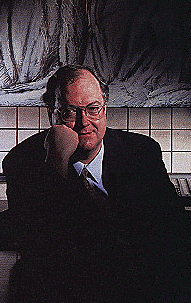
Theo tak terikat pada suatu lembaga keuangan. Kalau mau main, ia sendiri yang menentukan. Sejak tahun lalu, ia mendirikan perusahaan jasa konsultasi pasar uang Speed Currency. Bagi yang ingin tahu atau ingin main valas boleh jadi pelanggan. Dengan membayar AS $ 100/bulan, Theo pun memberi analisis dan panduan.
“Cita-cita saya membuat Speed Currency seperti Bloomberg. Ia besar dan disegani, meski awalnya juga dirintis di garasi,” ia menunjuk garasi di rumahnya yang berhalaman luas di kawasan Lebak Bulus, Jakarta Selatan. Ia mempekerjakan 4 orang yang, selain mengolah analisis, juga bertindak sebagai fund manager. “Mereka jago-jago yang tak bisa dianggap remeh, karena lewat tangannya sering terjadi transaksi miliaran dolar,” kata Theo bangga.

Karena bekerja di rumah, Theo tak terikat pada aturan dan jadwal kerja yang pasti. Ia adalah pegawai bagi dirinya sendiri. Juga pegawai yang mengantar anak-anak ke sekolah, menemani mereka bepergian, bahkan mendampingi saat mereka mau tidur.
Theo menganggap, anak-anak lebih memerlukan kebersamaan ketimbang uang. Tak soal ia telah punya vila di Puncak, Jawa Barat, dan hotel di atas tanah 10 ha di Manado. Anak-anak pula yang menghadirkan cerita unik bagi perjalanan hidup Theo. Saat masih di dalam kandungan, kecuali si bungsu Daniel (hampir 2 bulan), mereka berada di tempat yang jauh dari rumah. Dari yang sulung tempatnya paling jauh, sampai si bungsu yang paling dekat. Namun akhirnya semua lahir di Jakarta.

Menurut istrinya, Sandra Pingkan Adriana Lolong (38), si sulung Monika (12) berada di dalam kandungan saat mereka di New York . “Barulah 2 bulan menjelang melahirkan, saya kembali ke Jakarta,” kata Sandra. Begitu pula Abi (9) yang dikandung saat mereka tinggal di London. Keisha (7) anak ketiga, dikandung di Singapura. Sedangkan Dorothea (5) dikandung sewaktu mereka di Manado. Barulah anak ke-5, Daniel, menghabiskan seluruh masa janin hingga lahir di Jakarta.
Jumlah anak sampai 5, bagi pasangan Theo dan Sandra juga cerita tersendiri. Theo memang dari keluarga besar, namun Sandra hanya 2 bersaudara. Setelah kelahiran Abi, keduanya ingin ber-KB. “Tapi apa mau dikata, kebobolan terus. Selain mengalami beberapa kegagalan, saya pun pernah kehilangan spiral,” kata Sandra. “Akhirnya, setelah melahirkan Daniel, saya minta disteril.”
Buat pasangan ini, anak-anak adalah segalanya. Mereka yang terbiasa memanggil “Papa Theo” adalah rekan sepanjang hidup, sekaligus jadi rem manakala Theo terlalu keasyikan bermain uang. (G. Sujayanto/A. Heru Kustara/Mayong S. Laksono)

The Top Trader : Richard Dennis

Published on: Selasa, 02 April 2013 in
Richard Dennis


Richard Dennis must be saluted for his skills as a trader and teacher. His instruction to his students the turtles was a great story and trend following philosophy has stood the test of time.
Dennis himself has made hundreds of millions of dollars over the years. But while his students have had successful money management careers, Dennis seems to not mesh well with clients. If Dennis just traded for himself he would be fine (and much richer).


"I don't think trading strategies are as vulnerable to not working if people know about them, as most traders believe. If what you are doing is right, it will work even if people have a general idea about it. I always say you could publish rules in a newspaper and no one would follow them. The key is consistency and discipline."
Richard Dennis
"...he placed classified ads proclaiming 'trader wanted,' he got some 1,000 responses from people eager to learn his methods. He settled on fewer than two dozen novices--among them two professional gamblers and a fantasy-game designer--and after a two-week training program, he gave them money to trade under his firm's auspices. Several went on to become top commodity-fund managers..."

 "Unlike Eckhardt (and most other savants) Dennis believed that trading could be taught and learned. Eckhardt belonged to the you're born with it or you're not camp."

The Top Trader : William O'Neil

Published on: Senin, 01 April 2013 in
William O'Neil has been the authoritative voice of investors and stockbrokers all across the United States ever since he formed William O'Neil & Company in 1963; today the company works exclusively with institutional investors. The founder of Investor’s Business Daily and the inventor of the CAN SLIM investment stratagem – which limits losses to a 7% mark and outperforms even the S&P 500 -- O’Neil is a much sought after lecturer and mentor for up and coming stockbrokers and those who need a bit of extra help to get to their next levels of market achievement.
William O'Neil’s career in the fiscal landscape of America began in 1958, when he joined the firm of Hayden, Stone & Company as a stockbroker. Over the course of his initial tenure with the firm, he researched the intricacies of stock trading and also enlisted the help of the earliest available computers to model the successes and failures of stocks. He tabulated stocks all the way back to 1953 to track their developments, successes and also failures.
The fruits of this labor was the development of the CAN SLIM investment strategy, which is actually an acronym standing for current earnings, annual earnings, new product or service – all of these make up the CAN portion – followed by supply and demand, leader or laggard, institutional sponsorship, and finally market indexes, all of which denote the SLIM part.
O’Neill perfected his stratagem to such an extent that he managed to pinpoint consistently well performing stocks simply by ticking them off against his check list. This system has become so successful that it even outperformed the S&P 500. The secret to his success is the loss limitations which are – without exception – set at about 7% or slightly above, preventing the staggering investment losses of recent years.
Following his own guidelines, William O'Neil’s career at Hayden, Stone & Company took off and after only five years, in 1963, he left the firm to start his own investment management and also brokerage firm, known as William O'Neil & Company. At the scant age of 30, he bought himself into the New York Stock Exchange and plied his trade with stellar success.
10 years later, in 1973, O’Neil pioneered O’Neil Data Systems, a company that worked with cutting edge software and hardware components to publish databases. The company is still in business today. Nine years after that, in 1984, the groundwork for Investors Business Daily was laid and suddenly the Wall Street Journal, a publication which thus far had remained unchallenged, had stiff competition.
Over the course of his career, O’Neil veered away from private investors and instead began working with institutional investors on a national level. As of 2009, William O'Neil & Company work with roughly 400 investors and continue to follow the precepts of extensive market analysis to identify solid stocks and limit market losses.

The Top Trader : Martin Schwartz

Published on: Jumat, 29 Maret 2013 in

Martin S. Schwartz, known in the stock trade as Buzzy, is a formidable day trader who serves as example to virtually all aspiring stock traders. His first year as an independent stock trader netted him $600,000; he doubled this figure in the following year. Schwartz is quoted as revealing that he used to make about $70,000 per day trading, and on one day he actually netted several million dollars. As his frenetic trading consumed his life, a health related wakeup call forced him to slow down, and he has lived in a self imposed semi retirement and only participates in scaled backed trading from his Florida home. Martin Schwartz began his career with an education from Amherst College and later on Columbia University.

After a stint in the United States Marine Corps, he went to work as a financial analyst for E.F. Hutton. Once he saved up $100,000, he quit and used the money to buy himself into the American Stock Exchange as an active but independent trader. Schwartz became a formidable trader who worked with options, futures as well as stocks. After 12 months of trading independently, he reported earnings of $600,000; a year later, it was twice that. Fellow traders soon began to notice the frenzied pace with which he changed positions and that he never held on long to any financial instrument. This earned him the moniker of "day trader." Not shy about his fiscal prowess, Martin Schwartz participated in the U.S. Trading Championship that was organized by Stanford University and which consisted of nine matches.

Held in 1984 - at the onset of the day trading craze - he made a spectacular showing and beat out the other participants by earning more money than his competitors did together. This led to the adoption of the day trading model not only by a good many independent traders, but also by do it yourself dabblers at home. It is noteworthy that in a 1998 interview Schwartz alluded to the fact that the market --which was at an all-time high - was likely to have reached a cusp and thus was due for a market correction. Before long this highly successful businessman found himself addicted to the heady thrill of buying and selling at lighting speed, and nearly sacrificed his health and life in the process. Martin Schwartz detailed his accomplishments and also his failures in the book entitled "Pit Bull: Lessons from Wall Street's Champion Day Trader." At this point he lives in self imposed semi retirement and trades in a limited capacity from his Florida home.

The Top Trader: Stanley Druckenmiller

Published on: in
In 1975, Stanley Druckenmiller graduated from Bowdoin College where he studied English and Economics, with the desire to eventually to become a professor of those subjects. He began to work on a Ph.D. at the University of Michigan, but left the program to work at Pittsburgh National Bank as a stock analyst in 1977.
After only one year, he became head of the bank's equity research group. He was only 28 years old when he founded Duquesne Capital Management in 1981 with only one million dollars.
Then, in 1985, he accepted a position as a consultant to Dreyfus, compelling him to commute to New York for two days each week. By 1986, he became the head of Dreyfus Fund, with the agreement that he would continue managing Duquesne. In 1988, he accepted George Soros' offer of a position within Quantum Funds, replacing Victor Niederhoffer. Together, the pair "broke the Bank of England" by shorting the British pound, resulting in one billion dollars of profit in a single day.

After 12 years with Quantum Funds, Stanley Druckenmiller left the company to focus on developing Duquesne Capital Management, which has become quite successful. Forbes has Stanley Druckenmiller listed as the 91st richest person in America.

Track Record

In addition to the single day's one billion dollar profit take in 1992, Mr. Druckenmiller has been able to sustain outstanding results over long periods of time. He typically has achieved annual rates of return exceeding twenty-five percent over a 10 year period.
His sense of timing is one of the keys to his success. It has been said that he has an ability to get in and out of positions at just the right time. While Stanley Druckenmiller knew how to bet big, he also knew when it was time to back off.

Helping Others and Enjoying Life


While Mr. Druckenmiller has worked hard at managing multiple funds, he has clearly enjoyed some of the rewards of being the best forex trader in the world. With a 2008 net worth of 3.5 billion dollars, it is no extreme effort for him to maintain a fleet of over 12 different vehicles that are kept at his home at Southhampton. At the Teterboro airport one can find his multi-million dollar business jet, a Bombardier Global Express BD-700.

In addition to enjoying his "toys," Stanley Druckenmiller continues to provide millions of dollars each year to various philanthropic organizations. In 2009, he gave more money to charities than any other American. He also is chairman of the board of Harlem Children's Zone, a community-based, non-profit organization which was founded by a college friend of Druckenmiller's, Geoffrey Canada.

Insights From the World's Best

It's almost impossible to deny that Stanley Druckenmiller's is probably the best forex trader alive. His main focus has been on capital preservation and "home runs." If you stay away from negative return years while achieving some one hundred percent years, your long-term returns will be outstanding.
Druckenmiller also proves that success is not a matter of luck. His consistent returns demonstrate a sound underlying strategy along with the willingness to take occasional risks. His is a trading strategy that worked, and his success offers good insights for all forex traders.

The Top Trader : Larry Hite

Published on: Kamis, 28 Maret 2013 in
Lawrence D. Hite is a trailblazing investor who actively shaped the upcoming landscape of system trading as early as the 1980s. During his tenure with Mint Investment Management Company, he helped propel the commodity trading advisor to become the very first business in its discipline to report in excess of $1 billion in assets.

In an interview with author Jack D. Schwager for the book Market Wizards, Hite reminisces how he got started in commodities trading. He reveals that his college professor referred to commodities traders as crazy enough to trade on just 5% margins. A sudden realization struck him: it made sense!
While in college, Hite was a rock music promoter and managed musicians’ performances rather than their money. A sometime actor and screenwriter, he eventually got serious about staying with the music business. However, after several incidents caused him to question his career path, he decided to enter the world of investments as a stockbroker in 1968.

It was then that a chance comment made during a job interview set Hite on his path to successful commodities trading: Approach the business as a gambler playing the odds to win, rather than a stock market analyst who stays one step behind the market.

Larry Hite has built a reputation for taking hedge fund management to the next level. He is considered legendary in that he consistently managed to get clients actively involved in the trading method, leading to increased investor commitment to the entire trading process. A 1986 Business Week article jokingly sets him apart from what is termed a stereotypical “wild-eyed” trader in commodities.
The trading philosophy he embraces is as down to earth as it is practical: Larry Hite wants to know what you can afford to lose, rather than what your investment can net him. This differentiates his trading viewpoint from the more aggressive traders who in recent decades managed to reap great profits but also suffer great downward spirals.

Larry Hite cofounded Mint Investment Management Company and carefully grew it into the biggest and most influential commodity trading advisor firm of 1991. Of course, what would a reputation be without the facts to back it up? The Mint Guaranteed Fund – a Series A fund – proved to become a steadily leading frontrunner among 76 other publicly traded commodity funds. Hite also proved that cunning investment strategy, coupled with investor commitment, could benefit more than one fund. The Mint Limited Fund managed to rise 20% in 1986, which also is a rather respectable showing.
Not surprisingly, Hite has been frequently asked to divulge his secrets for success, and one thing that he stresses consistently is the need for diversification and cutting edge technology. Diversification is a means for reducing the risk inherent to trading. Technology, in the form of computerization, largely eliminates the human error component when analyzing data.

Even as far back as 1986 he strongly relied on computer modeling to gain an insight on futures trading in national as well as international markets. Over the course of time, he built a system that placed the investment behaviors of people as a constant, while making the commodities the variables. This simple process ensured not only a clear means of predicting future performances, but also provided him a fairly significant edge when it came to unloading commodities just before they lost substantial percentages of their values.
Hite never diverged from this strategy, and as computers and programs became more commonplace, he upgraded his software to remain on the cutting edge of the business. Back then – just as he does now – he advocated volatility tracking of at least 10 to up to 100 days in order to make an educated investment decision.

In 1994, Larry Hite retired as the hands-on fund manager at Mint. Since his retirement, he has held the position of managing director of Hite Capital LLC.

The Top Trader : Jesse Lauriston Livermore

Jesse Lauriston Livermore was an active trader during the famous stock market crashes of 1907 and 1929. He amassed a personal fortune totaling more than $100 million in 1929, and just a few short years later lost it all. In the course of his career he lost millions of dollars just as quickly as he earned them. Yet even decades after his suicide, his legacy is much sought after and although some disregard him as merely a stock trader dealing in hype and cashing in at the top, there are others who refer to him as an intuitive and gifted stock market genius.

At the tender age of 14, Jesse Livermore saw the inside of Paine Weber & Company for the first time. As a lowly clerk in 1891, his job consisted in transcribing stock prices from ticker tape to an actual board. Guessing on various trades’ profitability on intuition, he began betting on actual stock trades, and at the age of 15 he earned his first $1,000.

Jesse Livermore eventually left Paine Weber but continued to bet on stocks. By age 20 he managed to earn $10,000. When at the age of 21 he joined the New York Stock Exchange, however, he was not nearly as profitable trading stocks as he was betting on them. By the age of 22 he lost all of his money and had to request a loan to continue trading. At the age of 23 he started trading with $50,000 and at the end lost it all. Livermore blames the slow speed of the ticker for his fiscal demise.

Over the course of the year, Jesse Livermore learned to rely more on his hunches than the ticker tape, and through a shrewd short sale in 1907 he makes $1 million. By 1908 he is once again broke. After a bankruptcy in 1914, Livermore returns to trading and in 1916 amasses $3 million. He continues trading and in 1929 once again anticipates the market and sells short, making a huge profit of $100 million, yet in 1934 he is bankrupt for a second time. Six years later, Jesse Lauriston Livermore dies by his own hand.
Today’s stock traders look to Livermore as the quintessential, indomitable do it yourself millionaire who did not invest in costly courses or college educations, but instead learned stock trading on the job. As odd as his frequent wins and losses may sound, modern stock traders embrace the fact that hard work, intuition, and also a labor intensive study of the market can give virtually anyone the chance to realize a profit.

Of special interest are his innate abilities to profit during the 1907 and then also 1929 crashes. This skill, if stock traders could apply it today, would have preserved many a trader’s portfolio. Another important aspect of Livermore’s trading philosophy was the lesson to not look to insider tips as a surefire means of reading the market. Jesse Livermore attempted to do so – to his detriment – a number of times, and as such the lessons of his life are a powerful teaching tool for new traders.

Some have gone so far as to distill the lessons Jesse Lauriston Livermore taught them, and perhaps the most famous line is the one which encourages would-be traders to be in touch with their strengths but much more so with their weaknesses. Livermore’s legacy is one that counsels those who come after him to learn from their mistakes and realize that these mistakes are the opportunities for real learning. Successes, such as his multi million dollar trading profits, do not provide for real learning opportunities.

Top Trader: Jack D. Schwager

Published on: Rabu, 27 Maret 2013 in
Jack D. Schwager first entered the market in 1971. Since then, he has become a highly respected director of futures research and also a well known profiler of investment greats – many of whom he met while trading for Commodities Corporation. As a profiler, he has penned a number of successful books, such as “Market Wizards” – a term that spawned a whole Wall Street Wizard series – and also “Getting Started in Technical Analysis.” He has since made his mark in the hedge fund industry where he applies many of the lessons learned from his interviews and successfully manages the Fortune Group's Market Wizards Funds.

In 1971, Jack D. Schwager joined Reynolds Securities for a period of two years. With his MA in economics firmly in hand, he initially worked as a research analyst in a position that allowed him to delve deeply into the movements of the stock market. From 1973 until 1979, he worked as a director in charge of researching futures with the firm of Loeb Rhoades Hornblower. From there it was only a short leap to the position of director of research at Smith Barney, a position that Schwager filled from 1979 until 1983. This position served as a springboard to the famed Commodities Corporation for one year, then in 1984 he joined Paine Webber, and in 1988 Prudential Securities; he remained with this company in a number of positions until 1999.

Jack Schwager and Commodities Corporation are virtually synonymous. Not only did he work for this financial services corporation, but during his tenure he rubbed elbows with a number of investment and trading greats. He familiarized himself with the methods of Ed Seykota, Bruce Kovner, Louis Bacon and also Michael Marcus. After researching their methods and systems, Schwager came to the realization that trading profitably is not random success or the luck of the draw. While compiling his works on Wall Street trading and stock investing – the famous Market Wizards series comprised of “Market Wizards,” “New Market Wizards,” and “Stock Market Wizards” –

Schwager soon noted that savvy trading requires an intimate knowledge of human psychology. Moreover, methodical investing far surpasses kneejerk reactions to market ups and downs when trading.
In a 2003 interview, Jack Schwager revealed that successful stock traders must be disciplined and experienced money managers with an eye on controlling risk; they also must employ methodologies that are in tune with their individual personalities. This seasoned stock trader and author has come to learn that simply applying another investor’s systems or trading methods will not yield similar results, especially if this system does not fit the individual trader’s unique mental and intuitive approach to the stock market.
Jack Schwager opines on his takes on investment strategies and cautions readers not to get caught up in the details of other traders’ successes but instead maintain a steady eye on the underlying current that appears to be synonymous. As such, he cites that virtually all of the successful traders with whom he had a chance to speak would have a well defined ceiling for their position size when it came to the short side. This served as a failsafe and would not allow their portfolios to become unbalanced with a short position that went over a predetermined percentage.

It is Schwager’s take on the reason for so many fiscal losses – especially in recent months and years – that have elevated his books to cult status: with the help of copious interviews and meticulous comparison of facts and data, he suggests that loss prevention is equivalent to disciplined risk control. As such, he cautions traders to not just manage risk, but instead control it from the get go. Schwager urges traders to stay away from staying in a position past the point of reason and overtrading.
He believes that an attempt of regaining losses rather than cutting them leads to a lack of discipline when it comes to risk control, and as such losing investors and traders fail to see market conditions and declines which are obvious to others. Jack Schwager has taken all of the lessons learned from his interviewees and is now applying them to hedge fund management, which he considers to be a viable and profitable alternative to standard investing. Not surprisingly, today he manages the Fortune Group's Market Wizards Funds.

The Top Trader: Alexander Elder

Published on: in ,
Alexander Elder, M.D. is a native Russian who defected to the United States at the tender age of 23. He has since worked as a New York City psychiatrist, Columbia University professor, and expert stock trader. Drawing heavily on his psychiatry background, Dr. Elder was so successful that he is the author of a number of stock trading insider books, and also a much lauded speaker and trainer. It is a little known fact that he began his stock trading experience by buying one stock: KinderCare.
Alexander Elder is an enigma in the world of stock traders; he not only understands the details of the transactions, but also the mindset of the traders before, during and after the business deal. More importantly, he has successfully transferred this knowledge to common market behavior, making him the trader with an edge that those attending Dr. Elder’s seminars eagerly seek to imitate.
According to Alexander Elder, there are three stages to trading:

1. The trader who is technically well versed but devoid of an understanding with respect to the human component.
2. The trader who realizes that in spite of technical knowledge there is no guarantee to success. As such, he will attempt to recreate the mindset and decisions he made during successful stock trades, and avoid those that he made during unsuccessful ventures. Dr. Elder calls this the awakening of a psychological understanding with respect to stock trades.
3. This trader understands that successful stock trading requires control and money management. Rather than letting stats and positions move him, it is the management of the money and the control thereof that causes him to anticipate future positions.

It is interesting to note that – unlike so many other traders turned author – Alexander Elder freely acknowledges that while trading for a living is most certainly a workable lifestyle, it requires an extensive amount of discipline and a significant bit of work before the first trade is even made. This makes it an unsuitable goal for a good many stock traders who are attempting to go it alone. As a matter of fact, when Dr. Elder teaches a seminar, he freely acknowledges that the majority of participants are likely to fail.
He sees his role as a mentor to those stock traders who have the right personality to keep trading. Dr. Elder recalls his epiphany with respect to trading in his book entitled “Trading for a Living.” He remembers that after reading “How to Buy Stocks” there was the definitive moment in time when he realized that there was an entire world of money making out there, of which he was thus far unaware. What is more, Alexander Elder remembers that even though he knew nothing about stock trading, he started out slow, with a stock in KinderCare.
Over time he studies the ups and downs of the market, learned about the intricacies of stock trading, and finally shifted his career focus to trading stocks as well as options. Dr. Elder finally settled on trading futures as the vehicle that is netting him the most income. He decided to practice psychiatry part time, usually after the markets have closed for the day. Alexander Elder is noteworthy for plainly advocating that there is no secret to success when it comes to trading.
Subscribe to our RSS Feed! Follow us on Facebook! Follow us on Twitter!