qas30

--== It is Not Random But Designs ==--
Having trading discipline is the beginning; keeping discipline is the progress;
staying discipline is the success

How to Lose Millions in Speculative Currency Trading


Australia's largest bank, National Australia Bank (NAB), lost hundreds of millions of dollars in speculative currency trading. The scandal broke out in January 2004 when a fellow trader working in the Melbourne office of the bank exposed unauthorized foreign currency derivatives trading. Initial reports had indicated that the total loss could be as high as A$600 million but Australian Prudential Regulation Authority (APRA), country's banking regulatory body, found that the currency trading scandal has cost the bank A$360 million.


In its detailed report on the scandal released on March 24, 2004, APRA found that the board of the National Australia Bank had been lax in regulation and supervision of currency risk management system. In its report, APRA recommended 75 improvements to restore confidence in the bank. These improvements include closing down of foreign currency options operations of NAB and increasing capital reserves by A$700 million until new trading limits and better risk management controls are put into action. APRA has also recommended that NAB should increase its capital adequacy reserves ratio to 10 per cent, which stood at 9.7 per cent at the end of September 2003.


The findings of APRA are consistent with an independent review into the scandal by accountancy firm PricewaterhouseCoopers (PwC). The PwC review had also found that the currency traders had exploited loopholes and weaknesses in the NAB’s system to hide trading losses. Although the scandal was uncovered in January 2004, the PwC review found that currency traders were concealing losses for several months.

With a market capitalization of A$45.8 billion, NAB is the largest stock in the Australian financial markets. The revelation that the NAB had lost hundreds of millions of dollars on unauthorized currency trading sent shockwaves to the financial markets. The scandal wiped out almost A$2 billion from bank’s market capitalization within few days.

Undeniably, the currency scandal has severely dented the reputation of the NAB but this is not the first time that the bank has been hit by a scandal and suffered huge losses due to poor risk management controls. In 2001, NAB had to write down A$3.6 billion from the purchase of US mortgage business, HomeSide. Millions of dollars were also lost in a fraud when NAB lent money to buy fictitious coaches. In fact, just six months before the latest currency trading scandal, APRA had cautioned senior management of NAB about its lax approach towards risk management systems in currency trading.

In the aftermath of scandal, several senior staff members of NAB have lost their jobs and the board has been restructured. The so-called “rogue traders” — Luke Duffy, David Bullen and Vince Ficarra in Melbourne and Gianni Gray in London — have been dismissed and are under investigation by the Australian Federal Police. While NAB Chairman Charles Allen and Chief Executive Frank Cicutto have resigned.

The currency trading scandal at NAB was the result of a combination of factors including greed, arrogance and lax regulatory and supervisory framework. In October 2003, “rogue traders” at NAB were trading highly leveraged call options on the Australian and New Zealand dollar in the anticipation that these currencies would fall against the US dollar. But their speculative bets were wide of the mark. Instead of falling, Australian and New Zealand dollar rose substantially against the US dollar between October and December 2003. With these currencies gaining strength, the currency traders at the NAB were losing millions of dollars every day.  If “rogue traders” had closed positions as the market moved against them, the losses would have been minimal. Instead, they doubled their bets in order to recover initial losses. Taking advantage of loopholes and weaknesses in the bank's system, they also entered fictitious currency transactions in the books to cover up their losses.


What is astonishing is that fictitious currency transactions and breach of trading limits went unnoticed for months at the NAB despite a plethora of internal checks and balances. It was only on January 9 2004, when a fellow trader noticed discrepancies in trading accounts and alerted the management. At that time, “rogue traders” had incurred a loss of A$185 million. Two weeks later when the entire currency portfolio of the bank was restructured, the total losses increased to A$360 million.


To some extent, blame lies with the behavior of four “rogue traders” at the NAB who were known for their aggressive approach in currency trading. All in their early 30s, “rogue traders” were so consumed by “profit is king” culture at the NAB that they overlooked warning signals. The year-end bonuses from currency trading gave them additional incentives to conceal losses and create illusionary profits through fictitious trading. Despite highly paid, currency traders earn more money through bonuses. The four “rogue traders” each received bonuses between A$120000 and A$265000 for the financial year 2002-03, almost double their annual salary. Gary Dillon, the bank's global head of foreign exchange, received a bonus of A$500000 last year on top of a hefty salary.


Although much attention has been paid in the media about the role of four “rogue traders” in perpetuating fraud at the NAB, but several important contributory factors have been largely ignored. To a large extent, lax regulation and supervision at the NAB provided conducive environment for “rogue traders” to carry out huge speculative bets on currency derivatives. It is difficult to believe that “rogue traders” were trading beyond their daily limits without the tacit approval from the higher authorities at the NAB. As per media reports, “rogue traders” had breached trading limits on as many as 800 occasions in the year 2003 and, at one stage, had an unhedged foreign exchange exposure of more than A$2 billion. It is implausible that senior management at the NAB was unaware of non-compliance of daily Value at Risk (VaR) limits and other standards by traders.


On the contrary, senior management at the NAB ignored the violation of trading limits and other standards since “rogue traders” were generating handsome profits for the bank through speculative bets in currency markets. In the words of David Bullen, one of the four traders, “We were over the limits and they were being signed off on a daily basis...so my boss was aware, his boss was aware and then other areas of the bank were aware of this type of thing. You know, it's not like, you know, [you] can hide limits and stuff like that from the rest of the bank…All they [senior management] ever really wanted was for money to be made, and the way that came about was secondary.”


It is also difficult to believe that fictitious transactions went unnoticed by the back office of the bank for almost three months. When a currency transaction is completed in the trading room, it is passed to the back office of the bank for recording. Confirmation of the transaction also comes from outside the bank, from the counterparties of the transaction. The agreed transaction is then entered into the bank's accounting system. It is inconceivable that the counterparties did not inform the back office of NAB about their transactions for almost three months. All these developments corroborate the contention that the scandal is not limited to only four “rogue traders” and back office of the NAB is equally involved in it.


It is evident that some of the lessons from earlier derivative scandals have not been learnt. One of the main lessons learnt from the Barings scandal was the need for complete separation and autonomy between the trading room and the back office of the bank. But in the case of NAB scandal, we have seen how back office fully connived with the trading room.


This scandal has busted several myths associated with the risk management systems of banking sector. First, banks and financial institutions do not have better governance and risk management systems than the non-financial corporate sector. Second, technical solutions and models (e.g., VaR), howsoever sophisticated these may be, are of little help in preventing the financial fraud.


The NAB scandal also reflects the growing dependency among banks and financial institutions on currency speculation and other risky businesses to reap higher profits. As deregulation and rampant competition from foreign banks have eroded their profits, banks are increasingly resorting to speculative activities in currency markets. Banks are the biggest players in the global currency trading. The global currency market is the largest market in the world. Since the breakdown on Bretton Woods system in the early 1970s, currency trading has increased manifold. Nowadays, over US$1.2 trillion is traded on an average every single day in global currency markets, whereas in 1977, the daily turnover was just $18 billion.


Since foreign exchange markets are extremely volatile and pose a systemic risk, their phenomenal rise has been a matter of serious concern. According to the Bank of International Settlement (BIS), daily spot transactions have declined over the years but currency trading through derivative instruments has witnessed a dramatic increase. Unlike spot transactions, currency derivatives (e.g., currency options, currency futures and currency swaps) are less transparent. Moreover, trading in currency derivatives is not only restricted to banks and financial institutions. Recent evidence suggests that non-financial institutions and transnational corporations are increasingly trading in currency derivatives. It is generally claimed that transnational corporations indulge in currency derivatives to protect their overseas businesses from foreign exchange risk but the possibilities of misusing currency derivatives to book speculative profits cannot be denied.


Although derivatives are supposed to help in reducing risk, they have become one of the biggest sources of volatility and instability in the global financial markets. Warren Buffett, the world's greatest stock market investor, recently described derivatives as financial weapons of mass destruction. In the Annual Report of Berkshire Hathaway (2002), Buffett stated “We view them [derivatives] as time bombs both for the parties that deal in them and the economic system ... In our view ... derivatives are financial weapons of mass destruction, carrying dangers that, while now latent, are potentially lethal.” Since derivatives are highly leveraged instruments, a small fluctuation in prices and exchange rates can cause huge losses to parties involved in such transactions and thereby pose systemic risk. We have seen how the collapse of massive hedge fund Long-Term Credit Management (LTCM) in 1998 had almost brought the global financial system to its knees.


In global currency markets where the risks and rewards are astronomical, the possibilities of frauds are also enormous. No wonder, the world is increasingly witnessing a series of currency trading scandals. Some scandals have come out in the open while others remain buried. Two recent scandals involving banks are cited here. In 2002, AllFirst Financial, a subsidiary of Allied Irish Bank — Ireland's second largest bank — lost US$750 million on foreign currency options trading when its trader, John Rusnak, systematically falsified bank records and documents to hide losses from speculative bets. Rijecka Banka — Croatia’s third largest bank — lost US$100 million (nearly three-quarters of the bank’s capital) in March 2002 when its currency dealer, Eduard Nodilo, indulged in unauthorized foreign exchange trading to hide past losses. In the aftermath of this scandal, the German bank, Bayerische Landesbank, sold its 59 per cent share in Rijecka Banka to the government for a symbolic price of US$1. The growing list of currency trading scandals calls for greater regulation of banks involved in currency trading, particularly currency derivatives.


To sum up, the NAB currency trading scandal not only demonstrates that very little has changed in the past one decade, but also raises fears of recurrence of it if policy makers remain oblivious of their responsibility to regulate banks as well as global currency markets.

The Forex Market: Who Trades Currency And Why

Published on: in
The foreign exchange market (or forex market) is the largest financial market in the world. In fact, the market for currencies is several times larger than the stock market.

TUTORIAL: Introduction to Currency Trading
This is the place where one currency is exchanged for another, and it has a lot of unique attributes that may come as a surprise for new traders. Here we take an introductory look at the forex market and how and why traders are increasingly flocking toward this type of trading.

What Is Forex?
An exchange rate is the price paid for one currency in exchange for another. It is this type of exchange that drives the forex market.


There are more than 100 different kinds of official currencies in the world. However, most international forex trades and payments are made using the U.S. dollar, yen and euro. Other popular currency trading instruments include the British pound, Australian dollar, Swiss franc, Canadian dollar and Swedish krona.

Currency can be traded through spot transactions, forwards, swaps, and option contracts where the underlying instrument is a currency. Currency trading occurs continuously around the world, 24 hours a day, five days a week. (The line between profitable forex trading and ending up in the red may be as simple as choosing the right account. Who Trades Forex?
There are many players in the forex market:


  • Banks
    The greatest volume of currency is traded in the interbank market. This is where banks of all sizes trade currency with each other and through electronic networks. Big banks account for a large percentage of total currency volume trades. Banks facilitate forex transactions for clients and conduct speculative trades from their own trading desks. When banks act as dealers for clients, the bid-ask spread represents the bank's profit. Speculative currency trades are executed to profit on currency fluctuations. (Currencies can provide diversification for a portfolio that's in a rut. Find out which ones you need to know, in Top 8 Most Tradable Currencies.)
  • Central Banks
    Central banks are extremely important players in the forex market. Open market operations and interest rate policies of central banks influence currency rates to a very large extent.

    Central banks are responsible for forex fixing. This is the exchange rate regime by which a currency will trade in the open market. Floating, fixed and pegged are the types of exchange rate regimes.
    Any action taken by a central bank in the forex market is done to stabilize or increase the competitiveness of that nation's economy. Central banks (as well as governments and speculators) may engage in currency interventions to make their currencies appreciate or depreciate. During periods of long deflationary trends, for example, a central bank may weaken its own currency by creating additional supply, which is then used to purchase a foreign currency. This effectively weakens the domestic currency, making exports more competitive in the global market. (Central banks use these strategies to calm inflation, but they can also provide longer-term clues for forex traders. For more, see How Inflation-Fighting Techniques Affect The Currency Market.)
  • Investment Managers and Hedge Funds
    After banks, portfolio managers, pooled funds and hedge funds make up the second-biggest collection of players in the forex market. Investment managers trade currencies for large accounts such as pension funds and endowments. An investment manager with an international portfolio will have to purchase and sell currencies to trade foreign securities. Investment managers may also make speculative forex trades. Hedge funds execute speculative currency trades as well.
  • Corporations
    Firms engaged in importing and exporting conduct forex transactions to pay for goods and services. Consider the example of a German solar panel producer that imports American components and sells the final goods in China. After the final sale is made, the Chinese yuan must be converted back to euros. The German firm must exchange euros for dollars to purchase the American components.
    Companies trade forex to hedge the risk associated with foreign currency translations. The same German firm might purchase American dollars in the spot market, or enter into a currency swap agreement to obtain dollars in advance of purchasing components from the American company in order to reduce foreign currency exposure risk. (Hedging against currency risk can add a level of safety to your offshore investments. For more, see Protect Your Foreign Investments From Currency Risk.)
  • Individual Investors
    The volume of trades made by retail investors is extremely low compared to that of banks and other financial institutions. But the forex trade is growing rapidly in popularity. Retail investors base currency trades on a combination of fundamentals (interest rate parity, inflation rates, monetary policy expectations, etc.) and technical factors (support, resistance, technical indicators, price patterns).
Clearly, forex market participants trade currencies for very different reasons. Speculative trades - executed by banks, financial institutions, hedge funds and individual investors - are profit motivated. Central banks move forex markets dramatically through monetary policy, exchange regime setting, and, in rare cases, currency intervention. Corporations trade currency for global business operations and to hedge risk. (The use of margin to trade in the foreign exchange market can magnify profit opportunities. For more, see Adding Leverage To Your Forex Trading.)

Forex Traders Shape Business
The resulting collaboration of forex traders is a highly liquid, global market that impacts business around the world. Exchange rate movements are a factor in inflation, global corporate earnings and the balance of payments account for each country.

The popular carry trade, for instance, highlights how market participants influence exchange rates that, in turn, have spillover effects on the global economy. The carry trade, executed by banks, hedge funds, investment managers and individual investors, is designed to capture differences in yields across currencies. It is the process of borrowing low-yielding currencies and selling them to purchase high-yielding currencies. For example, if the Japanese yen has a low yield, market participants would sell it and purchase a higher yield currency.
When interest rates in higher yielding countries begin to fall back toward lower yielding countries, the carry trade unwinds and investors sell their higher yielding investments. An unwinding of the yen carry trade may cause large Japanese financial institutions and investors with sizable foreign holdings to move money back into Japan as the spread between foreign yields and domestic yields narrows. This may result in a broad decrease in global equity prices.

The Bottom Line
The carry trade highlights how forex players impact the global economy. Investors can benefit from knowing who trades forex and why they do so.

SingTel Stands to Get Forex Gain in Any Optus Satellite Sale

Published on: in
Singapore Telecommunications Ltd. (ST) stands to benefit from a 45 percent rise in the Australian dollar against its home currency in any sale of the Optus Satellite division it bought in 2001.
A strengthening of the Aussie over the past decade left revenue at the unit 41 percent higher last year in Singapore dollar terms than it would have been without the change in exchange rates. The unit of Southeast Asia’s largest phone company may be worth as much as A$2 billion, Nomura Holdings Inc. estimates.
SingTel, as the Singapore-based company is known, said yesterday that it had appointed Credit Suisse Group AG and Morgan Stanley to conduct a strategic review of the unit. Potential buyers include European and north American satellite companies, such as Intelsat Global Holdings SA, Eutelsat SA, SES SA, and Inmarsat Plc, as well as infrastructure funds, said Jeffrey Tan, an analyst at OSK Holdings Bhd.
“Those names are trying to widen their footprint in Asia,” Tan said by phone from Kuala Lumpur. “The Asian satellite operators are busy ramping up their own capacity” so are less credible buyers, he said.
Optus Satellite’s revenue was A$222 million during its 2001 financial year, according to statements filed during Cable & Wireless Optus Ltd.’s takeover by SingTel. That was worth S$206 million in SingTel’s home currency, based on the exchange rate used during the takeover.
The A$319 million of revenues the division recorded in 2012 was worth S$417 at the company’s reported exchange rate for that year, 41 percent more than the S$295 million that would have resulted at 2001 rates.

Aussie Gains

The Australian dollar traded at about 1.296 Singapore dollars as of 6:15 p.m. Tokyo time, about 45 percent more than on March 16, 2001, the day Singtel announced its A$17 billion ($17.6 billion) takeover proposal for Cable & Wireless Optus, which included the satellite business.
“No decision has been reached on the future plans for the business,” Michele Batchelor, a spokeswoman for SingTel, said by e-mail. “The Optus Satellite business remains a strong performer and good investment.”
A sale will face hurdles because of the national security implications of selling satellites that carry Australia’s defense communications, said Simon Morris, a Melbourne-based partner with Corrs Chambers Westgarth who’s given legal advice on cross-border transactions. It would also need to be approved under U.S. rules on the export of satellite technology.

Defense Signals

“Everyone reads the headlines saying ‘The next war’s going to be an I.T. war’,” he said by phone. “In that sense it’s understandable why there’d be concern over anything that relates to communications or I.T.”
Approval of the deal would pass through the Foreign Investment Review Board, a government agency that approves overseas purchases of Australian assets, Morris said. While it probably wouldn’t need a separate defense review, as relevant government agencies are consulted as part of the Board’s usual process, it would attract more scrutiny because of the nature of the business, he said.
“Anything that is defense-related, there’d be another layer over that,” he said. That would reflect “China-type concerns.”
Huawei Technologies Co., China’s largest maker of telecommunications equipment, has been excluded from public tenders on a state-owned national broadband network being built in Australia. The decision was taken “in the national interest,” Prime Minister Julia Gillard said last March.
Luke Coleman, a Sydney-based spokesmen for Huawei, declined to comment.

’Cyber Intrusions’

Optus Satellite’s C1 orbiter carries communications for Australia’s military, including secure messages and imagery that’s sent to troops out of sight of Australia’s coast, according to a 2003 statement by the country’s defense minister.
Australia’s Defence Department needs to provide written consent “before any change in the interests of the satellite can take place,” according to an e-mailed statement from the ministry. All its contracts relating to the satellite will expire by the end of this year and the department is evaluating tenders for future services from Optus, according to the statement.
Cyber security has become a sticking point in bilateral talks between China and the U.S. National Security Adviser Thomas Donilon said March 12.
“Cyber intrusions emanating from China at a very large scale” are threatening to derail U.S. President Barack Obama’s efforts to improve ties between the countries, Donilon said. Such accusations were groundless and China itself is a victim of hacking attacks, Premier Li Keqiang said March 18.
“The scale of certain countries’ cyber operations and the nature and level of those intrusions have been substantial,” Ross Babbage, a Canberra-based security consultant and former Australian defense adviser, said by phone. “This has not facilitated trust in foreign investment.”

Trade Like A sniper : M1 Trade

Published on: Selasa, 19 Maret 2013 in ,
M1 trade sample:


Trade Like a Sniper. Koreksi terkecil yang ada di chart ya M1, pola bentukan koreksi awal sekali akan ada di M1, butuh extra kehati2an dalam Trade di TF terkecil ini, pola koreksi walau akan terjadi tetap pembacaan Trend terjauh wajib dilakukan.

Kenapa...?? karena seburuk2 trade jika tidak melawan trend terjauh tidak akan jelek hasilnya, pemanfaatan M1 sebagai pola area koreksi dimanfaatkan semaximal mungkin untuk area re entry.

Perpotongan MA bukan merupakan basic Trade saya dalam M1, retrace koreksi dalam batasan - batasan di M1 yang betul - betul saya manfaatkan, kasarnya begini : " Toh saya bisa trade and Run Anytime, kemudian saya sudah bisa profit duluan dibandingkan mereka yang trade berbasic MA dengan menunggu MA cross".

Profit bisa saya bawa/closed kapan saja nyentuh atau tidak sentuh TP saya, karena memang yang saya ambil hanya M1.

sukses.

Commodities Slump as Cyprus Sparks Declines From Oil to Copper

Published on: Senin, 18 Maret 2013 in
Commodities fell as Cyprus rekindled concern that Europe’s debt crisis may deepen, with copper dropping by the most in five months, pacing declines in industrial metals and oil. Rubber and wheat also slid while gold rose to a two-week high.
The Standard & Poor’s GSCI Spot Index of 24 raw materials fell 0.8 percent at 11:16 a.m. Seoul time while copper for delivery in three months dropped as much as 2.7 percent, the biggest loss since Oct. 19, to a four-month low of $7,545.75 a metric ton on the London Metal Exchange. Rubber futures tumbled 3.8 percent to 272 yen in Tokyo, while crude futures for April delivery dropped 1.4 percent to $92.16 a barrel in New York, set for the biggest daily loss since March 1 on closing price basis. Wheat futures for May delivery lost 1 percent at $7.1475 a bushel in Chicago.

Euro finance ministers reached an unprecedented agreement on March 16 forcing depositors in Cypriot banks to share in the cost of the latest euro-zone bailout. While Cyprus accounts for less than half a percent of the single-currency economy, the concern is that the one-time tax on accounts could trigger bank runs across Europe and further destabilize the financial system.
“The Cyprus issue is the biggest driver of sharp falls in commodities across the board as that is pushing the euro lower and the dollar higher,” Lelia Kim, a trader at Seoul-based Tong Yang Securities Inc., said by phone today. “Coupled with weak data out of the U.S., which is ruining recent recovery optimism, industrial metals are being hit hardest, while gold is rising on safe haven demand.”
The Thomson Reuters/University of Michigan preliminary U.S. consumer sentiment index for March fell to 71.8, the lowest level since December 2011, from 77.6 in February. The gauge was projected to increase to 78, according to the median estimate of 67 economists surveyed by Bloomberg.
Gold for immediate delivery advanced as much as 1.1 percent to $1,608.60 an ounce, the highest since Feb. 27, before trading at $,1594.89. The Dollar Index, a gauge that measures the strength of the greenback against six major rivals, jumped 0.7 percent to 82.838. The euro slid against the dollar to its lowest level since Dec. 10 and traded at $1.2903.

Barclays Warns On China

Published on: Minggu, 17 Maret 2013 in
Barclays Capital is getting more cautious about China.
The investment bank that has been mildly bullish on China for much of the last 12 months said investors should proceed with caution heading into the second quarter.
The reasons?
The soft January-February data and news flow from the National People’s Congress
support a more cautious view on China’s growth recovery, urbanization drive and reform.
Core inflation surprised on the upside because of food prices this week. Barclays said investors should expect neutral monetary policy with a bias toward tightening liquidity through open market operations.  The bank regulator, the CBRC, is already tightening regulations around wealth management products and local government lending.  The reigns are being pulled closer to the chest.
Industrial production growth in China slowed to 9.9% year over year in the January-February period, in contrast to the general expectation of a pick-up (consensus was 10.6%). It was also lower than the 10.3% recorded in December and the 10% recorded in the fourth, suggesting there may be some destocking due to the Chinese New Year holiday.  In that case, restocking on the back of a recovery in end-user demand should support a rebound in industrial production and the PMIs in March, if all goes swimmingly well.
China retail is still humming along.  Although the hum is not as loud as it once was.  Compared to much of the rest of the world, China still looks like a boom town. Retail sales growth decelerated to a 2-year low of 12.3% (Barclays estimated 14.5% and consensus estimates were even higher; 15.2%).  In December, China retail sales rose 15.2% December and 14.9% in the fourth quarter.
On the other hand, fixed asset investment (FAI) growth re-accelerated to 21.2% on the year, more in line with market forecasts and above last year’s average of around 20%. The government is back to spending on railroads and — as the bears might say — Chinese bridges to nowhere.
The breakdown in China FAI shows that infrastructure and property investment remained strong, which offset a further slowdown in the manufacturing sector.  The build-out in real estate continues as China assumes the urbanization trend has years to play out. Around 50% of Chinese live in cities, compared to around 75% of Americans.
Meanwhile, Barclays warns that Beijing will need to curb the investment enthusiasm of local governments, as two thirds of them have set 10%-plus growth targets for 2013.  Barclays thinks they’re being overly bullish.
“We will monitor how the central government promotes its ‘urbanization drive’,” said Barclays economist Jian Chang in a note to clients on Friday.  That urbanization trend will impact the investment and consumption outlook for years to come.  The question is whether some cities have overdone it, meaning the boom will end sooner than expected as second and third tier cities look to fill in vacancies at residential and commercial developments before they mix more concrete to build more.
China shares have been disappointing.  The iShares FTSE China is down 7.4% year-to-date ending March 15.  The MSCI China index isn’t doing much better. It’s down 5.7%.
Major China stocks trading on the NYSE have suffered all year as well.
Search engine Baidu (BIDU) is down 15.17%.  Sina Corp (SINA) is down 3.8%, a winner by most estimates. China Mobile (CHL) is off 9.43%.  Medical equipment maker Mindray (MR) is a standout, though.  It’s up 17.37% year-to-date.
Audrey Kaplan, a portfolio manager at Federated Investors and manager of Federated InterContinental (RIMAX) told me two weeks ago that China may be down, but is not out.
“It’s a disappointment. But we are okay with that. You can buy China at a discount, which is great for long term investors,” she said, adding that China is a stock pickers market for those who have the patience.

Trade Like a Sniper

I outlined how a trader's very achievement motivation can lead to "pressing": trying so hard to make trades happen that trading plans and rules are abandoned. This often happens when traders become frustrated with losses or slow markets and try to make up for the lack of results by sizing positions too aggressively or by taking too many positions. Traders press when they feel pressure, whether for profits, for action, or to achieve competitive advantage over other traders.

The result is a loss of self-control, as aggressiveness takes over and judgment takes a back seat. Successful trading may be discretionary or system-based, but it should always be rule-governed: controlled by basic considerations of risk management and opportunity. Indeed, this might be an apt definition of poor trading: when the need to trade overwhelms the need to preserve and add to capital.

One of my favorite posters in my office is of a military sniper in the field, peering out from ground cover. The caption beneath the picture reads, "The sniper's greatest weapon is a sharply honed intellect. He combines a mastery of stealth, situational awareness, ballistics and precision shooting skills into one of the most lethal weapon systems to ever strike fear into the enemy."

If the sniper became too aggressive and excessively bored with sitting in the field waiting for the right shot, he might leap from his cover and begin spraying the enemy with fire. Most of the shots would probably go wild, and the out-of-control sniper would quickly be located and mowed down.

No, the sniper waits for the ideal shot: "stealth" and "situational awareness" are essential tools of the trade. Being a sniper means combining aggression with exquisite self-control and judgment. It is controlled aggression.

Over the years, I've learned to trade like a sniper by not placing one trade after another in rapid succession. When a trade is concluded, I go flat and wait for a fresh setup. During the waiting time, I refresh my "situational awareness" (assessment of market conditions, my own condition), and return to my basic trading rules.

The idea is to trade only when I have an unobstructed view of the target. Everything else is waiting and preparing, staying low in a defensive posture. It's the time between those shots at the target that provide the self-control. It is difficult to press if you take the time to reassess, reload, and return to cover after an errant shot. With repetition, that reassessment and reloading become automatic: your default mode becomes one of self-control.

Plan. Trade. Reassess plan. Trade: It's a rhythm that combines the best of achievement motivation and aggression with the best of judgment and forethought. It's a beautiful feeling to plan one good trade, execute it to perfection, and then sit back and wait for the next opportunity. Any performance skill, honed and executed with precision, is a kind of work of art. I think the best snipers understand that.

Tahun 2013, Krisis Keuangan Diperkirakan Masuk Indonesia

Published on: Jumat, 15 Maret 2013 in ,
Pengamat Ekonomi Universitas Gadjah Mada Anggito Abimanyu memprediksi krisis ekonomi global yang melanda Amerika Serikat dan Eropa akan pelan-pelan melanda ke Indonesia pada 2013. “Mungkin pada kuartal ke-empat,” katanya saat dihubungi Tempo Selasa 13 September 2011. Dampak ini tidak langsung masuk lantaran Indonesia memiliki fundamental ekonomi yang bagus sejak tahun lalu.

Menurut Anggito krisis sulit dihindari oleh Indonesia lantaran krisis sekarang lebih berat ketimbang krisis 2008. Alasannya jika krisis 2008 bisa ditanggulangi dengan stimulus fiskal melalui utang sekarang ini negara-negara memiliki defisit anggaran yang besar ketimbang produk domestik bruto. Selain stimulus fiskal, lanjut Anggito, negara-negara yang tergabung dalam G-20 mampu melakukan penurunan suku bunga. “Sekarang ini, tidak banyak instrumen untuk menanggulangi krisis,” ujarnya. Situasi saat ini, menurut Anggito, belum ditemukan instrumen untuk mencegah krisis.

Anggito mencontohkan krisis di Amerika Serikat yang belum pulih. Mantan Kepala Badan Kebijkan Fiskal Kementerian Keuangan ini menilai Amerika tidak bisa menggunakan utang untuk memulihkan ekonominya. Biasanya, stimulus fiskal untuk penanggulangan krisis atau ekspansi ekonomi Amerika Serikat selalu bermodalkan utang. Namun kali ini defisit anggaran Amerika Serikat sudah melebihi 100 persen dari produk domestik bruto. “Kalau nambah utang Amerika akan terkena down grade (penurunan peringkat utang),” ujarnya.

Adapun ekonomi Indonesia, menurut Anggito, masih bisa bertahan lantaran fundamental yang bagus. “Pengalaman 2008 biasanya kita cukup tahan,” katanya. Kebijakan Bank Indonesia menarik devisa hasil ekspor dan kredit luar negeri agar disimpan di lembaga keuangan dalam negeri, menurut Anggito, merupakan langkah yang tepat. “Tapi biasanya itu dilakukan dalam keadaan damai,” ujarnya pada saat rapat dengar pendapat dengan Komisi Keuangan Dewan Perwakilan Rakyat Senin 12 September 2011.

Kebijakan ini, menurut dia, bisa menciptakan rumor negatif bahwa di Indonesia juga terjadi krisis ekonomi. Namun pendapat Anggito disanggah oleh Direktur Econit Henri Saparini. “Kalau tidak sekarang kapan lagi,” ujarnya.

Selain penarikan valuta asing, menurut Anggito, pemerintah harus menggenjot Innitial Public Offering (IPO), stabilisasi surat utang negara, dan membuat kebijakan agar penempatan dana asing di dalam negeri menjadi lebih lama. Kebijakan IPO BUMN oleh pemerintah, menurut Anggito, dirasakan kurang lantaran jumlah IPO BUMN menurun beberapa tahun belakang. Apalagi Menteri BUMN Musatafa Abubakar memutuskan tidak akan ada lagi BUMN yang IPO di semester kedua tahun ini.

Krisis ekonomi global, membuat Gubernur Bank Indonesia Darmin Nasution pesimis target pertumbuhan ekonomi pemerintah 2012 sebesar 6,7 persen bakal tercapai. Menurut Darmin krisis ekonomi di Amerika Serikat dan Eropa telah menurunkan pertumbuhan ekonomi dunia sehingga menurunkan perdagangan internasional.

Menteri Keuangan Agus Martowardojo mengatakan krisis di Amerika Serikat tidak berpengaruh langsung terhadap ekspor Indonesia. Namun jika krisis Amerika Serikat mempengaruhi ekspor Cina, Jepang, dan India, rentetannya akan berdampak kepada Indonesia lantaran ekspor Indonesia ke tiga negara tersebut sangat besar.

 Krisis Uni Eropa Akan Berdampak Besar Pada Indonesia

Uni Eropa memang dikenal dengan rasa kesatuannya yang kuat. Namun mata uang Euro yang mempersatukan mereka, justru membuat situasi sulit untuk negara-negaranya. Krisis utang di zona Eropa ini mempunyai efek domino berkat kesepakatan satu mata uang di wilayah Eropa tersebut. Walaupun Indonesia bukan bagian dari Uni Eropa, tapi seluruh dunia dapat merasakan dampak krisisnya. Ini dikarenakan Benua Eropa didominasi negara maju yang mempunyai peran penting bagi negara-negara lainnya. Efek dari kondisi ekonomi yang buruk tersebut sampai hingga ke Tanah Air. 
efek domino
Indonesia berpotensi terkena krisis lagi! Pernyataan ini didukung oleh fakta yang dijabarkan Aviliani, ekonom dari InDEF (Institute for Development of Economics and Finance). “Kalau di Eropa ada negara yang utangnya jatuh tempo, orang ketakutan mau menaruh uang dimana pun. Jika kecenderungan di sana beritanya buruk, investor asing mengambil uang di pasar modal kita,” jelasnya. Contohnya, saat investor asing yang menarik dana berjumlah cukup besar sewaktu krisis di Yunani tahun lalu, Indonesia berpotensi krisis. “Beruntung BI cepat tanggap, sehingga tidak terjadi likuiditas,” ujar Aviliani. Faktanya, sewaktu krisis lalu orang cenderung ingin memegang uang cash karena merasa lebih aman. Sewaktu Jerman menawarkan akan membantu keadaan ekonomi tersebut, para investor asing kembali menaruh uang mereka. Tetapi, jika kabar dari salah satu negara Eropa, Italia misalnya, tidak bisa bayar utang mereka, kita harus mempersiapkan diri karena Indonesia terancam kena krisis lagi!
Bersiaplah, pasar Cina akan menyerbu Indonesia! Sebagai salah satu pengekspor terbesar, akan sulit bagi negara Cina untuk memasuki wilayah Eropa dikarenakan krisis yang melanda. “Yang dikhawatirkan adalah dengan ditutupnya pasar Eropa karena krisis, maka barang-barang ekspor Cina akan dialihkan secara besar-besaran ke Indonesia,” jelas Ratna Sari Loppies, Ketua komite Tetap Hukum dan Pengamanan Perdagangan. Serbuan barang Cina tersebut membuat panik pasar domestik Indonesia. Karena, diprediksikan akan menurunkan jumlah produksi dan juga penjualan dalam negeri. Hal ini dapat memicu adanya kerugian finansial serta pengurangan tenaga kerja (PHK) yang menghasilkan melejitnya tingkat pengangguran. “Satu-satunya cara untuk mengantisipasi keadaan buruk ini adalah dengan menjaga daya saing dan juga pasar domestik dalam negeri,” tambahnya.

Read The Price Action Is The Way For Successfully Trader

Published on: Kamis, 14 Maret 2013 in ,


To successfully trade Price Action a trader must be able to identify if a market is trending or ranging. Once this has been assessed clear levels for support or resistance must be marked for possible setups to trade either long or short.

Identifying the Trend

Technical traders use can use many different tools to identify the trend such as moving averages, however the best tool the trader has at their disposal is their eyes. After much experience and chart time a trader begins to get a feel for how a market is unfolding and moving.
When learning to identify trends it is always best to start on the larger time frames such as the daily charts. These larger time frames hold the key to all the big moves in the market. The chart below shows the daily chart of the EURUSD which is in a very obvious down trend.

chart1 2/19/12


Trading with the trend in your favour is always the best course of action. Often you will hear that “the trend is your friend” and this is very true. The reason for this is that the overall trend normally continues until some sort of major support or resistance in the market is hit, or a large fundamental change in one of the economies involved occurs. A pattern in the market that may signal a trend is under way is known as the “1,2,3 pattern”. This pattern is made up of 3 legs of price movement. For a bearish trend the pattern is made up of;
1. Price falls lower
2. Price retraces and creates lower high
3. Price falls lower again and creates a new lower low

In the chart below we have an example of this pattern. We can see that price first went lower before then retracing and creating a lower high. The pattern was then confirmed when price went lower and created a lower low.


chart2 2/19/12


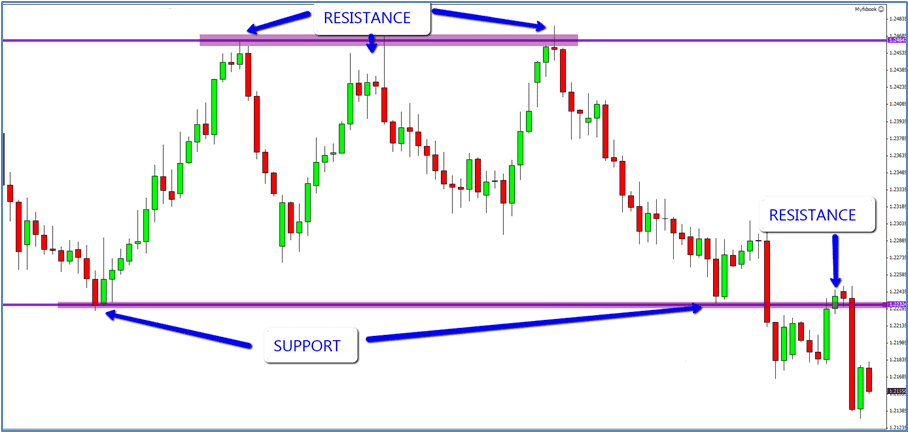
Marking Support and Resistance Support and resistance is a very important part of the Forex market. Price will often bounce or move away from support or resistance so learning how to mark these levels correctly is critical.
To mark support and resistance we need to mark the most obvious levels on the larger time frames charts such as the 1 day chart. The levels we plot on the daily chart will guide us when trading on the intraday charts such as the 4hr and 1hr.
Below is a chart of the daily EURAUD. Only the very clear and obvious levels have been marked. Take note just how closely price respects these areas.


chart3 2.19.12


Waiting For Price to Reach Key Levels
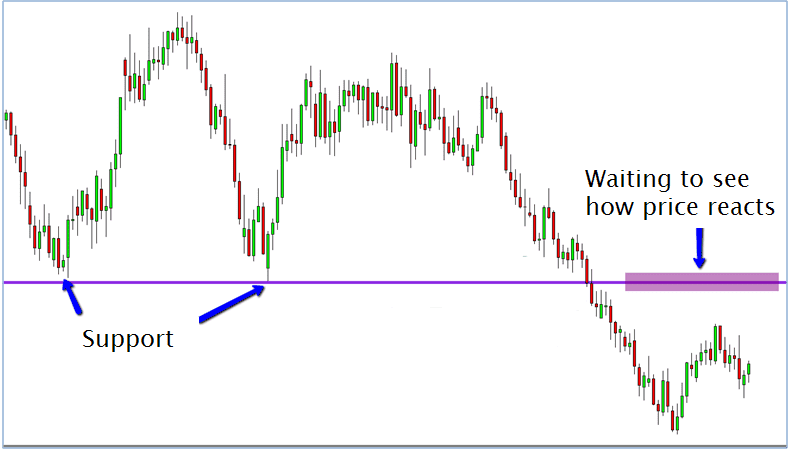
Once support and resistance levels have been marked clearly on a chart, the next job of a Price Action trader is to watch and wait for price to reach these important levels in the market. Price Action gives clues all the time as to what direction it is looking to trade in.
Traders should pay particular attention to what price does when it reaches the support and resistance levels and whether price rejects these levels or breaks out. Traders all over the world are watching these levels and watching for trading opportunities.
The following chart shows an example of an area that traders would be watching and waiting for price to reach.

chart4 2/19/12


Matching Price Action Setups with Support and Resistance Once traders have worked out the strength and direction of the trend and also identified the key places in the market they would like to enter, they then need to learn to trade Price Action signals from these key areas.
Examples of powerful Price Action signals are;
The Pin Bar Reversal
The Engulfing Bar
The 2 Bar Reversal

Traders can learn the ins and outs of how to trade Price Action signals through a course such as Forex School Online’s Advanced Price Action Course
To successfully trade Price Action setups traders will need to learn everything about the setups, including how to enter, how place stops and how to correctly manage trades once they are in them.

Putting it All Together

Trading with as many factors in your favour is going to increase the chance of placing a winning trade. Smart traders try to trade with as much confluence as they possibly can. When looking to trade Price Action signals try to trade with;
The trend in your favour
From key levels in the market
Reliable and proven Price Action signals

Trading Price Action does not need to be a made complicated. The traders that usually turn out to be the successful Price Action traders always look to trade with as many market factors in their favour as they can.

FOREX-Dollar rallies across the board, cheered by US jobs data

Published on: in
* Dollar/yen hits highest level since August 2009
* Euro falls to three-month low against the dollar
* U.S. jobs data well above expectations

NEW YORK, March 8 (Reuters) - The dollar surged to its highest in more than three years against the yen and a three-month peak versus the euro on Friday, bolstered by a report showing the U.S. economy created more jobs than expected last month, pushing the unemployment rate to a four-year low. The greenback also posted its best weekly performance against the yen in two months. It also gained versus the euro for a fifth straight week. The jobs report, suggesting the economy has developed enough momentum to withstand the blow from higher taxes and deep government spending cuts, fuelled speculation that the U.S. Federal Reserve will tone down its ultra-loose monetary policy sooner than anticipated. Data showed that non-farm payrolls surged in February, with employers adding 236,000 jobs, handily beating economists' expectations for a gain of 160,000. The jobless rate fell in February to 7.7 percent, the lowest since December 2008, from 7.9 percent in January. "Chants of 'USA! USA!' echoed on the trading floor (after) a very strong employment report was published this morning," said Sean Cotton, vice president and foreign exchange advisor at Bank of the West in San Ramon, California. "The data fits the story of an economy that has weathered the early stages of the fiscal drag extremely well." The euro fell against the dollar, erasing gains from Thursday when European Central Bank President Mario Draghi gave less dovish policy signals than expected. It dropped as low as $1.2955, its weakest level since Dec. 11 and was last down 0.8 percent at $1.2999. Nearly US$3.0 billion in euros changed hands on Friday, using Reuters Dealing On the back of better-than-expected U.S. non-farm payroll figures, Rabobank has revised lower its three-month forecast for euro/dollar to $1.28 from $1.30. Over the next few weeks, the bank said the euro is likely to maintain a "jittery range" around the $1.29-$1.32 level. Against the yen, the dollar climbed as high as 96.54 yen , its strongest level since August 2009.

It was last at 96.11, up 1.4 percent, the dollar's best daily performance in almost a month. Around $3.8 billion in yen were traded on the Reuters Dealing platform. The yen seems likely to remain under pressure as investors, looking past the Bank of Japan's decision to hold policy steady on Thursday at its April meeting, expect new officials to take aggressive action to beat deflation. If the BoJ expands its stimulus program next month, that could open the way for a test of 100 yen, said Ronald Ip, director of wealth solutions group for HSBC Global Markets, in London. BNY Mellon capital flows data showed that the U.S. dollar has been steadily net bought for four consecutive sessions, with U.S. stocks also largely in demand. Most of the U.S. stock purchases came from foreign investors, which is another source of support for the dollar, the bank said. "The summation of our investor activity in recent weeks suggests market participants have been increasingly favoring the dollar, which is no longer out of favor during risk-on investor sentiment, while still retaining its safe-haven allure during bouts of risk aversion," said Samarjit Shankar, director of market strategy at BNY Mellon in Boston.

EURO STEADIES The euro rose 0.5 percent against the yen to 124.92 yen , with the session peak at 125.95 yen, the highest since Feb. 13. Investors' expectations of future rate cuts in the euro zone, however, remained a focal point, reinforced by comments from International Monetary Fund head Christine Lagarde, who said the ECB should lower rates. Jane Foley, senior currency strategist at Rabobank in London, acknowledged the downside risks currently lurking in the euro zone. "The results of the Italian elections has so far failed to cause significant disruption in peripheral bond markets but the impact has the potential to breed uncertainties for weeks and even months," Foley said. In addition, Morgan Stanley analysts said in a note to clients that the downward revision of euro-zone growth forecasts and the below-target inflation forecast continued to provide the ECB with flexibility for future cuts in interest rates. They said any rebound in the euro against the dollar was an opportunity to sell for an eventual decline toward $1.27/1.28.

Treacherous Times for Hedge Funds

Published on: in


The stock rally, low fixed-income yields, plateauing commodities and legal pressures have mired hedge funds in uncertainty, raising questions about handling the ever-shifting market environment amid growing frustration by many investors.
Investor unrest stems from a slew of issues, ranging from high fees to a feeling that many professional investors are largely missing the historic equities rally that began in 2009. During the first two months of the year, the average hedge fund was up 2.67 percent, according to HFR, whereas the Standard & Poor's 500-stock index rose 6.2 percent. Returns for specialized hedge funds, such as commodities funds, have been relatively poor, with long-biased funds and some event-driven funds two of the bright spots.

Unsurprisingly, hedge fund managers like Omega Advisors' Leon Cooperman, who has been bullish on the stock market for well over a year, and Appaloosa Management's David Tepper, whose championing of the so-called Bernanke put, which suggested that the Federal Reserve's program of quantitative easing would poise the stock market for huge returns, have performed exceedingly well.
Tepper remains bullish, according to someone familiar with his thinking, and predicts an upsurge of 20 percent or more this year if economic improvements continue. "We are still constructive the market," he told CNBC of his outlook.

Other hedge fund managers, though hoping to capitalize on the market's froth, are less secure about the S&P's trajectory, worrying that a hiccup in March or April could interrupt their gains or that an overbought market could lead to precipitous losses this summer.

Forex Market Structures

Published on: Rabu, 13 Maret 2013 in ,
You want to examine what the stock market is all about, and in order to compare it to the Forex market, you need to figure out what the stock market actually looks like or how it is ran.


Centralized Market
Buyers   >      Highest Person (Controller)      <   Sellers
The stock market is a monopolistic place to be in, and there is actually only one entity. This is one specialist who controls all of the prices, which is the middle person in the graph above. All of the trades made in the area have to go through this one person. These prices can then be altered to benefit the specialist in the position and actually hurt the traders in the end. This is something that almost always happens.

The specialist in this position is forced to fulfill all of the orders that come from the clients. If the number of sellers was more than the number of buyers, then the specialist, who is forced to fulfill the client’s needs, has to leave a bunch of stock to the sellers that he cannot sell off to the buyers that are in this trade. If you want to prevent the specialist from doing this, then the specialist can simply widen the spread that everyone is using or even increase the cost of transaction to prevent any of the sellers in the market from entering this specific trade. This actually allows the specialist to manipulate the quotes and the figures to fit everyone’s tastes, if they so choose to do so.

Decentralized the Trading Spot for Forex

You do not actually need to go through a centralized exchange like the Stock Exchange in New York using just one flat price each time. In the Forex field of the market, there is nothing stating that there is a single price for any given currency at any time. This allows you to have the idea that quotes differ from dealers and prices will vary from day to day.
This is something that many people find a lot to handle since there are many different components within the graph. This is what makes the Forex market what it is, however. This is because you want the largeness of the market each time you trade for the competition, that the dealers put off, giving you the best deal that you can get each time. You are able to do Forex trading wherever you would like, which means no crazy loud stock market to run to every day. It is done just like if you were to trade cards of a favorite sport.

Learning More about the Forex Ladder
The Forex market is a decentralized area, and the people in the market can be categorized through a series of ladders. You can find out for yourself where each person and company fits on the ladders below:

The top of the market ladder in the Forex industry is the interbank market. This is one of the largest banks in the world and also includes the smaller banks who participate with the larger bank. They also trade directly to and from each other, and electronically through EBS systems. They can also use the Reuters Dealing 3000 Spot matching to do the job, and do it right.
The competition between the EBS and Reuters Dealing 3000 Spot Matching is tough and tight. They each want to make it out the best, yet the competition is tough. They are always battling over clients and want the higher of the market share in the end. They both offer a number of currency pairs, although some of the currency pairs are more liquid than the others that they offer. In the EBS system, EUR/USD, USD/JPY, EUR/JPY, USD/CHF, and EUR/CHF are more liquid than any others. For the Reuters system that is used, it is a bit different coming in as GBP/USD, EUR/GBP, USD/CAD, NZD/USD, and AUD/USD are the more liquid of the group.
All of the banks that are within this group at the interbank market can see each of the rates that are offered, yet not all of them can make deals on the prices at hand. The credit relationship between the two parties is dependent on the rates and vice versa. The better the credit standing, the better the reputation with them and you will have the better interest rates with the largest loan that you can get.
The hedge funds, retail market makers, and corporations of retail ECNs in the ladder. Since these institutions do not have a tight credit ratings and relationships with the participants of the interbank market. These markets have a higher transaction via commercial banks. Their rates are slightly higher than the people in the interbank market and can be more expensive in the end.
The bottom of the ladder holds the retail traders of the market. These people are at the bottom because it is very hard for them to engage in the market. Now that times have changed however, the internet allows the little people to trade and enter the Forex trading barrier that once stopped them.


Why Trade in Forex Market

Published on: in ,
1. Forex is the largest financial market in the world.
The Forex market has daily volume of over $3 trillion per day, dwarfing volume in the equity and future markets combined. Such a huge amount of daily volume allows for excellent price stability in most market conditions. This means you likely will never have to worry about slippage as you would when trading stocks or commodities. The price you see quoted on your trading screen is the price you get.
2. Trade whenever you want; 24 hours a day 6 days a week.
There is no opening bell in the forex market. You can enter or exit a trade whenever you want from Sunday around 5pm EST to Friday around 4pm EST. There are 3 distinct trading sessions for you to take advantage of in the U.S., Europe, and Asia which allows you to trade on your own schedule and respond to world-wide breaking news. While it is possible to trade some stocks and commodities in the after hour electronic session, the liquidity is often very low and this makes prices extremely uncompetitive.
3. Commission free trading and overall low transaction costs.
A stock trade will cost anywhere from $5 to $30 for an online stock broker and typically up to $150 per trade for a full service broker. Futures brokers generally charge between $10 and $30 round turn, this means you pay between $10 and $30 to enter and exit every trade. Most forex brokers offer little or no transaction fees, they are compensated through the bid/ask spread of each currency pair. Typically these spreads are as little as 1.5 to 5 pips, depending on the broker and currency being traded. So essentially the only fee associated with a forex trade is that you start out being a few pips negative on every trade due to the bid/ask spread.
4. Market transparency and Instant execution.
Market transparency is much greater in forex than in stocks or commodities, this means it is easier to analyze the inner workings of the market and figure out what is driving it. For example, economic reports and news announcements that drive a country’s economic policy are widely available and accessible for anyone interested. Whereas an individual company’s accounting statements are much harder if not impossible to obtain. Instantaneous order execution is another great advantage forex has over other markets. Retail forex trading is generally done over the internet on all electronic platforms. The forex market has no central exchange, no open-out cry pits, no floor brokers, and was designed to be this way to facilitate large banks and allow for instant execution of transactions, this means no delays for you and extreme ease of execution.
5. Low margin requirements.
Forex margin requirements were recently raised in the U.S. but at a maximum of 1:100 this is still much higher leverage than you will get in the futures or equity markets. This means you can control 100,000 worth of currency for only 1,000, or 1%. To compare, in the futures markets traders must post margin equal to between 5%-8% of the contract value while stock traders typically must post at least 50% margin. Leverage can be a double-edge sword however, as an increase in leverage leads to an increase in risk but also in profit potential.
6. Price movements are highly predictable in the forex market.
Due to its highly speculative nature forex price movements tend to over shoot and then correct back to the mean. This means there are a number of repetitive patterns that are easily recognizable to the trader who is trained in price action analysis. Forex currency pairs generally spend more time in very strong up or down trends than other markets, this is also a huge advantage because it is generally much easier to trade a strongly trending market than a chaotic and consolidating market.
7. Equal opportunity to profit in rising or falling markets.
The forex market has no structural bias as do most stock markets. For example, most stock markets have a bullish bias, this means traders tend to like the long side or upside of the market more and as a result of this it is actually more difficult and generally requires more margin to sell short in a stock market. This is not the case in the forex market. As an inherent feature of the structure of the forex market it is equally easy to buy or sell at anytime and there is never any increased fee for selling short. In fact, each time you buy a currency you are simultaneously selling another, and vice versa. The ability to buy or sell at any time with no penalties is another advantage the forex trader has over those trading other markets.
8. No constraints on the number or type of transactions.
The futures market sometimes will have what is called a “limit up” or a “limit down” day, this means when the price moves beyond a pre-determined daily level traders are restricted from entering new positions and are only allowed to exit existing positions if they desire to do so. This is meant to control volatility, but because the futures market for currencies follows the spot forex market the next day at the futures open their sometimes will be large “gaps” or areas where the price has adjusted over night to match the current spot forex price. Now, if you were holding a futures position over night it is entirely possible that your stop got gapped around, in which case you would get filled at the next best price, which often will be extremely damaging to your trading account. Due to the 24 hour nature of the spot forex market even in extreme market volatility traders generally don’t have to worry about gaps and can almost always get out at the exact price they want.
9. Mini and micro accounts make it easy to get started.
There are many forex brokers that are easily accessible on the internet. Unlike futures or stock markets it is not going to benefit you much if at all to have a full service broker in forex. Most of the bigger forex brokers all offer tight spreads and very similar price feeds, they also all offer demo accounts that let you test out your trading ideas before risking real money. Another great thing about the forex market is that you can get started with as little as $250. Micro accounts allow you to trade position sizes as small as 1 cent per 1 pip movement. This means you can effectively control your risk even if you are not starting with much money. In the futures or stock market not starting with at least $10,000 is a big factor in why people lose so often.

10. Forex price movement lends itself wonderfully to price action setups.

Due to the speculative and contrarian nature of the Forex market prices tend to continue in one direction for a decent move and then revert back to the mean or value-area. More often than not these big moves are tipped off with a price action signal. If you are trained by a professional trader in the art of price action analysis you can design an entire trading plan around a few simple yet effective price action setups. Some of these patterns re-occur on a regular basis on the 4 hour and daily charts and can be extremely accurate. Due to the inherent high volume and large price movements, Forex is the best market to trade using price action analysis.

Central Bank

Published on: in
Central banks have emerged over the past four centuries when mankind moved from a system of gold or silver backed currencies to private issuers to fiat money. The first central bank in the world was the Swedish Riksbank, founded in 1668.
Scottish businessman William Paterson founded the Bank of England in 1694 on request of the British government to finance a war.
The First Bank of the USA was founded in 1791 and had a 20-year charter. It was however revived again in 1816 and gave birth to the Second Bank of the United States. This desperate move to stabilize the currency by US president James Madison was later revoked by US president Andrew Jackson who withdrew the bank's Federal Charter in 1836. In 1841 the Second Bank of the United States ceased all operations.
The history of central banking came alive again in 1913 with the constitutionally disputed foundation of the Federal Reserve.
As nearly all currencies in the world have transformed into fiat money over the past 4 centuries, i.e. the notes mandated to be used by government fiat, all countries have some sort of central bank that is responsible for keeping inflation low and provide a money supply that does not overshoot economic growth too much. Other tasks vary widely from country to country.
Political pressure has often led to inflation as rulers want to finance their activities with the in the first place seemingly cheap money.Image:Example.jpg

Central Banking

Central banks primarily purchase short-term debt issued by the governments of the countries in which they serve. Sometimes they've been used as a political piggy bank with the central banks buying riskier investments causing huge losses and inflation if the bank's government doesn't bail them out since the bank has no assets to sell to counter inflation, leaving to many banknotes in circulation.

Mencari titik terbaik entry

Titik terbaik entry sangat diperlukan untuk intraday, sebetulnya tidak hanya untuk intraday trade swingpun demikian, cuman pasti ada perbedaan, swing misalkan analisa TF D1-W1-MN1 lalu entry, atur MM, set target, SL, tinggalin, tidak perlu menunggu konfirmasi lagi di TF kecil, perkara harga akan koreksi dulu sebelum lanjut trend TF besar cenderung diabaikan, TP pun jauh, buka chart lagi check posisi tersebut 2-3 hari lagi, atau mungkin 1-2 minggu lagi bahkan 1-2 bulan kemudian atau mungkin juga tahun depan, Trade gak perlu ditungguiin sampai nongkrong depan PC lama-lama, umumnya swinger adalah trader yang memang "lebih mengarah pada investasi" atau punya aktifitas lain disamping Trade,bukan menjadikan Trade sebagai mata pencarian pokoknya dia.

Fulltime trader kan gak begitu, waktu terbaik untuk masuk ke pasar betul-betul ditunggu, entry gak bisa ngehold floating minus banyak-banyak sebelum kena target, bahkan op pun bisa di closed manually, sebelum kena target "setelah merasa cukup" atau ada analisa lainnya.

"Harga gak pernah bergerak lurus seperti sebuah garis" walau TF D1 misalnya confirm UPward, tetep saja akan ada koreksi - koreksi di bawah TF D1 tersebut, dan koreksi terkecil adalah TF M1 ( 1 menit ) :D,  maka saya memanfaatkan koreksi yang terjadi di TF terkecil tersebut dalam intraday saya, saya cari moment terbaik dan hanya entry ketika segalanya confirm secara technical saya.

10-20 pips juga kalau sering mah jadinya kan banyak :)


Sukses..

Wassalam

6 Reasons Failure In Trade

I hope you’re OK reader, after all that must have come as quite a shock. Now you’ve picked yourself up the floor, after reading the article title, which is a fact (well kinda), we’ll dwell on the subject at hand; why do so many lose at trading forex and what are the adjustments so many have to make in order to be in that top forty percent of winners?
OK, before we go any further let’s firstly deal with the 39% of winning traders quote. The fact comes as courtesy of forexmagnates in their redux lite version of a report covering the profitability and performance of USA based forex brokers. The leading figure was 39.1% client profitability from a broker who had circa 24,000 active accounts. There’s also other interesting snippets of information that are worth noting before we move on.
There was a steep fall in the number of accounts and activity levels in 2011 whilst the percentages of profitable traders increased. This could suggest a couple of interesting points, firstly are we collectively getting better at what we do? Or (and it’s not mutually exclusive) have a lot of ‘amateurs’ left the arena, gone back to the day job, leaving the numbers to be enhanced by the superior or more proficient traders? More importantly the number of brokers has shrunk, only the fittest of traders aided by most regulatory compliant firms will thrive.
  • Number of forex accounts held with US forex brokers drops by more than 11,000 to all time low of 97,206
  • Clients’ profitability is up 6.4% on average, second consecutive quarter that profitability is improvin
The US retail forex industry is now showing obvious signs of slow down, the number of non-discretionary retail forex accounts held with US based reporting brokers down to record 97,206, the lowest count reported since Q3 2010 when first such report was released. The extreme regulatory climate has made it extremely difficult for American brokers to attract new clients. However, out of the top ten forex clients listed the lowest recorded level of profitability was circa 32%.
It’s fascinating how many of us would receive a paradigm lightening bolt to our pre-conceptions when hit with the kind of figure that led this article. I’m not alone in taking ‘at face value’ some of the data and assumptions that come our way as forex traders. Instinctively I ‘knew’ that the unsubstantiated figure often hurled around trading forums; that only 10% of traders are profitable, was nonsense.
Having enquired at director level and read a comprehensive investors intelligence report, the reasonable figure for success was estimated at 20%, double the previous assumption, but 39% certainly took many by surprise the first time it was published, even more so that the top ten USA brokers have clients enjoying a 32% success rate. There is, however, a caveat, my twenty percent figure includes spread betters who could in theory be skewing the data due to being much worse traders (en masse) than pure play forex traders, a theory worth examining at a later date.
A question often raised by these type of success stats is “are a tiny percentage of successful traders distorting these figures?” But generally percentages, averages and the distribution of random data doesn’t work like that, and we should already know this being traders. If circa 40% of trades are profitable then the figure for the percentage of actual traders being profitable will be fairly close to that number.
In the first paragraph we posed the question why are so many traders unprofitable? Well armed with this new information I wonder if that assumption shouldn’t be examined in more detail. Firstly, out of the circa 97,000 live accounts held in the USA roughly one third are profitable, now not all of these account holders will be full time dedicated sole occupation forex traders, some accounts would be used as ‘punting’ accounts, folk who bet as opposed to trade (and we can save the obvious cerebral discussion on the difference for another time).


It’s impossible to gauge that breakdown of actual numbers of profitable traders from the information and data, but a figure above 50% would be a fairly safe bet and let’s just take our logic a stage further; in order to be full time, (for some time), the vast majority would have to be profitable, otherwise they’d simply give up the job. It’s interesting to note the further away we’re moving from this fantasy 10% figure the more we analyse a small piece of hard (audited) data.
There’s another aspect to this debate on success that’s also worth mentioning, perhaps supporting the view that FX is the best environment to trade in. If the wider trading success figure is closer to 20%, but the top ten USA FX brokers’ clients are all above 32%, then are we being delivered an obvious message there? If you want to enhance the probability of being a profitable trader then trade FX over and above equities, or indices and only consider using (dare I say it) an ECN/STP broker such as FXCC.
Here’s my own take on a more human level so to speak; I refuse to accept that anyone who has gone through my pain barriers over the past five years or so, who has gone to the extremes of discovery I realised was compulsory in order to become a consistently profitable forex trader, wouldn’t ultimately be successful and by successful I’d suggest a metric of taking a regular and reasonable salary or investment return of the forex market. And as I’ve stated on numerous occasions unless you attack our ‘forex challenge’ full time you’ll never ‘kick off the shoes’ and trade part time in a laid back fashion, that’s a luxury that only comes from experience.
Back to the question posed in the initial paragraph; “why do so many lose at trading forex and what are the adjustments so many have to make in order to be in that top forty percent of winners?” I’ll leave you with six reasons and please feel free to join in on the blog with your own suggestions or additions. Now I’m not about to ‘eulogise’ on the reasons and of provide solutions, it’s a straightforward list and there’s no riddle, the answers are there, the solution evident.
But firstly a recap, if close on forty percent of traders are successful then success as a profitable forex trader may be more in reach than you’d first envisaged. And that one figure, far higher than most would have anticipated, should be heralded as encouragement for fledgling traders.
Six Reasons For Failure

  • Low start up capital
  • Failure to manage risk
  • Greed
  • Indecision – doubting the plan
  • Trying to pick tops or bottoms
  • Refusing to be accept losses

Analisa AUD/USD

 1. PA pullback dari 72 nya Monthly, belum sanggup menembus 72 MN1.

2. W1 TF, belum ada perenggangan pada LR_TSF, walau PA sudah ada di area LR_TSF, namun tekanan sar W1 diatas masih bisa mendorong PA ke arah sar di bawahnya, jalan di W1 sudah terbuka dengan breaknya sar tersebut buat PA melanjutkan Trend W1.

3. H1 merupakan area entry ( intraday ) dan re entry ( swing trade )


H1 TF yang merupakan koreksi dari D1 TF , dengan membaca/melakukan analisa pada W1, bisa dijadikan asumsi untuk entry/trade, namun pada dasarnya Trade harus membaca trend, semua TF harus dianalisa, dikondisikan, mulailah dengan TF terbesar, ambil asumsi risk dan rewardnya, sesuaikan dengan style trade, intraday atau swing trade. Baca pula korelasinya, untuk hasil maximal.


PS: "closed manual jika merasa cukup"

semoga berguna..


The eurozone debt crisis is not yet over

Published on: in ,
THE eurozone debt crisis is not yet over, even if calm appears to have returned to the financial markets, the Bundesbank warned on Tuesday as it set aside billions of euros in new risk provisions.

"Even if reform policies are kept to, the necessary adjustments in the crisis countries are still going to take years," the head of the German central bank, Jens Weidmann, said.

"The growth rates seen before the crisis, which were partially artificially inflated, will not be achievable for a long time," he said.

Mr Weidmann also complained that policymakers in some countries still lacked a clear direction.

"The reform process has stalled in France; in Italy, the elections have cast a question mark over it; and the situation in Cyprus is even less clear," he said.

"The crisis is thus not over, despite the calm that has returned to the financial markets in the interim," the central bank chief insisted.

Turning to Germany, Europe's biggest economy which has managed to escape the recession that many neighbours still find themselves in, Mr Weidmann said: "the German economy was still in good shape ... despite the difficulties in many European partner countries."

Nevertheless, the long-running crisis "represents the most significant risk for the economy in Germany," Mr Weidmann said.

"Only some of the confidence lost as a result of the crisis has been recovered so far," he said.

As the year progressed, growth could be expected to become stronger, but this would depend on the absence of further shocks to confidence, he argued, insisting that it was up to politicians, not Europe's system of central banks to solve the crisis.

The Bundesbank's net profit for last year rose only slightly from a year earlier, because the central bank had decided to set aside billions of euros more in risk provisions, Mr Weidmann said.

The bank's 2012 net profit amounted to 664 million euros ($849.27 million), compared with 643 million euros in 2011.


Pound sterling could be the next victim of the global economic crisis says HSBC

Published on: Selasa, 12 Maret 2013 in , ,


Its latest report highlights a nasty ‘triple cocktail’ facing sterling as the US steps back from the fiscal cliff, momentum grows in China, and eurozone break-up fears diminish. HSBC warns, ‘The pound’s fiscal credibility is under threat as a sovereign downgrade looms.’


The pound sterling could slump this year as the problems of other currencies recede and refocus attention on problems like Britain’s persistent trade deficit and huge debts, according to HSBC.

‘The pound looks set to lose the contest of the uglies as its frailties emerge from the shadows,’ concludes HSBC. The bank expects sterling to lose about five per cent of its value against the US dollar and end the year around $1.50.

No safe haven

Sterling has benefited from safe haven status in the financial storms of the past couple of years and basked in the supposed benefited of independence from the euro. It looks as if the tables are about to turn.
As ECB president Mario Draghi pointed out at the start of the year the economic fundamentals of the eurozone do stand out as far sounder than most of the rest of the world. To that extent austerity is working, though it is not working for the millions of unemployed, particularly in southern Europe.
A cheaper pound might help exports but the cost will come in higher domestic inflation. This will gradually erode the real burden of debt carried by the UK economy but then again interest rates will also rise so the cost of carrying this debt will go up and not down.
With so many UK consumers dependent on low mortgage rates this would be a disaster for many domestic households. Higher interest rates would therefore tend to depress UK house prices that have been resilient in the face of the global economic crisis thanks to record low mortgage rates.


The economy shrank by 0.1pc in the three months to February, the National Institute of Economic and Social Research (NIESR) estimated, which followed a 0.3pc decline in the final quarter of last year. If figures show the economy contracted in the three months to March, the UK will officially be declared to be suffering its third recession since the financial crisis of 2008.
NIESR’s monthly GDP estimate was a slight improvement on the three months to January, which showed the economy declined by 0.2pc. However, it added that the data “suggest that the economy continued to flat-line in the first two months of this year”.
The bleak outlook followed official figures showing that output in the production industries, including manufacturing, shrank far more sharply than expected in January.
A slight improvement in the balance of trade for the month, published separately, provided little solace following the 1.2pc decline in industrial production between December and January, according to the Office for National Statistics. It was the weakest reading since September. Economists had expected expansion of 0.1pc.

The pound fell to $1.4832 at one point, the lowest level since June 2010 (Graph: Bloomberg)
Although the decline was once again caused largely by North Sea oil platform shutdowns, the UK’s manufacturing sector also disappointed. Following a 1.6pc increase in December, the sector – which remains the country’s largest single industry – declined by 1.5pc.
“This is the penultimate nail in the coffin in terms of triple-dip - it’s pretty much game over now,” said Alan Clarke, economist at Scotiabank. “Unless we have a stellar performance from the services sector, we’re almost certainly in a triple dip.”
The pound fell sharply against the dollar, touching $1.4832 at one point, the lowest level since June 2010.
The trade figures were a little better than hoped, with the deficit in goods and services in January shrinking slightly from £2.8bn in December to £2.4bn in January. The goods deficit, which some had feared would expand from £8.9bn to £9bn, shrank to £8.2bn.
The improvement was not driven by an increase in exports over the latest three months, but by a 2pc decline in imports. In fact, non-oil exports fell 5.4pc in the month, the worst decline since April 2012.
“This is suggestive of headwinds to UK economic activity, and could be consistent with further policy easing,” Steven Bryce, Credit Suisse economist, said.
He added about the industrial production figures: “This number more-or-less reverses the strong December reading, and leaves the first quarter GDP print potentially looking weak.”

Europhobia backfires
Does this mean the UK is going to suffer its own version of the crisis afflicting the peripheral states of the European Union with its independent currency backfiring badly? It could be that yet again the Europeans have the last laugh and the europhobic Britons end up paying for not being a full member of the club.
Certainly if you took Mario Draghi’s list of economic fundamentals that are sound in the eurozone, most of them would not apply to the United Kingdom. Currency devaluation might bring some relief but it is no cure all.
Here comes the day of reckoning for the UK!
Subscribe to our RSS Feed! Follow us on Facebook! Follow us on Twitter!